A car rider pickup line social story works best when it walks the student through the whole sequence: the dismissal signal, walking out, waiting, spotting the car, and getting in safely. The waiting and the noise are what trigger most meltdowns, so those get the most pages. In a 2024 community survey of 16 school SLPs, OTs, and parents, 94% reported spending 30 or more minutes writing a single story, and dismissal routines are one of the scenarios that come up again and again. A 2026 Frontiers in Psychology meta-analysis of 21 single-case studies reported a moderate overall effect, Tau-U of 0.743, with safety skills among the responsive outcome areas, which is the category pickup belongs to.
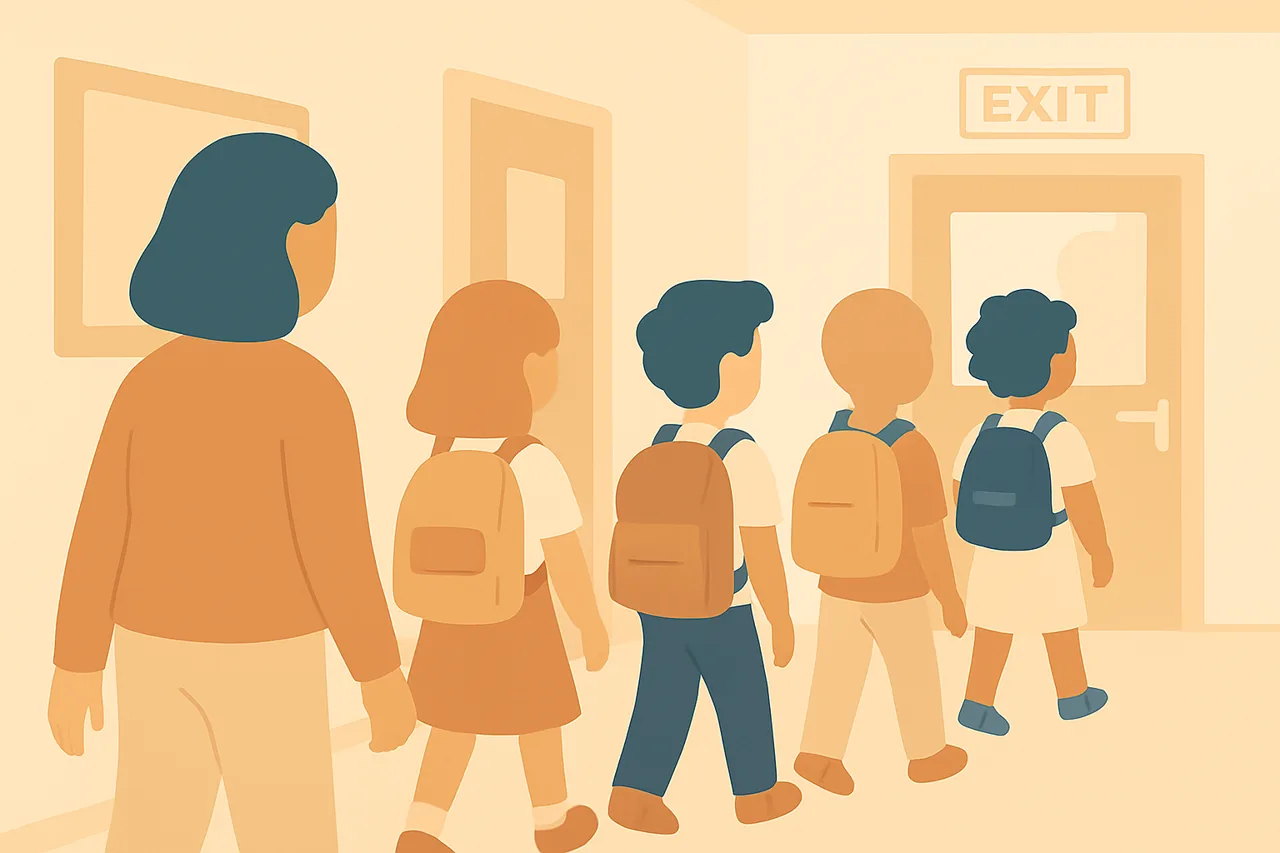
Why is the car rider line so hard for autistic K-5 students?
Because it stacks three hard things at once: an open-ended wait, loud unpredictable noise, and a visual search for the right car. A student who is fine in a structured classroom can unravel on a noisy sidewalk with idling engines and no clear signal for when their turn comes. The story's job is to make the invisible structure visible, so the wait has a shape and an ending the student can see coming.
What page beats should the story follow?
Map the routine to one idea per page. This 6-beat structure covers the whole pickup for most K-5 students:
| Page | Beat | Sentence type to lead with |
|---|---|---|
| 1 | The end-of-day signal happens | Descriptive |
| 2 | I pack up and line up | Descriptive |
| 3 | We walk to the pickup area | Descriptive + cooperative |
| 4 | I wait for my car (the hard part) | Perspective + one directive |
| 5 | I see my car and my grown-up | Descriptive + affirmative |
| 6 | I get in safely and go home | Descriptive + affirmative |
Notice that the single directive sentence lives on page 4, the waiting page, where the student most needs a clear action. The rest of the story describes and reassures. That keeps you inside the Carol Gray ratio of at least two descriptive or perspective sentences per directive.
What does a ready-to-adapt draft look like?
Swap in the student's first name, your school's exact routine, and the real pickup spot. Keep it lowercase "social story" on any shared materials, since Social Stories is a registered trademark of Carol Gray and The Gray Center.
- Page 1. At the end of the day, my teacher tells the class it is time to go home.
- Page 2. I pack my backpack and line up at the door. Lining up helps everyone stay together.
- Page 3. My class walks to the car rider area outside. My teacher walks with us to help.
- Page 4. Sometimes I have to wait for my car. Waiting is okay, even when the cars are loud. While I wait, I can stand on my spot and hold my backpack strap. If it is too loud, I can cover my ears or squeeze my fidget.
- Page 5. When I see my car and my grown-up, I know it is my turn. My grown-up is happy to see me.
- Page 6. I walk to my car safely and get in. I did it. Now I get to go home.
That draft runs about 10 sentences with a single directive on the waiting page. It reads in under a minute, which matters because a kindergartener has to sit through the whole thing before dismissal.
From the same 2024 survey, on why stories don't get made: real photos are the sticking point. "Getting suitable pictures is 90 percent of the work." For a pickup-line story, photos of your actual sidewalk, the line, and a generic car help more than clip art, especially for K-2 students who do not yet generalize from cartoon images.
How do you make the waiting page actually work?
Give the wait a job and an endpoint. An open wait feels infinite to a student who cannot see when it ends. Two moves fix this. First, name a physical anchor: a painted spot, a specific adult to stand near, or a strap to hold. Second, pair the one directive with a cooperative sentence so the student is not carrying it alone. "I can wait on my spot" lands better next to "My teacher will help me find my car." One school SLP phrasing from r/slp captures the anchor well: the student waits "by standing quietly and keeping my hands to myself."
How often should you read it, and does that matter?
Read it before pickup, not during, and re-read on a schedule. Aim for one or two readings before the first real pickup, then daily for the first week. Dosage is not a suggestion. In the 2024 ASSSIST-2 cluster randomized trial of 249 autistic children across 87 schools, students met their individual socio-emotional goals more often than peers in usual care, and the benefit grew with more sessions. Social narratives are also a reviewed evidence-based practice per AFIRM and the National Clearinghouse on Autism Evidence and Practice.
Frequently Asked Questions
What should a car rider pickup line social story cover?
Cover the whole sequence: the end-of-day signal, packing up, walking to the pickup area, waiting in line, spotting the right car, and getting in safely. The hardest parts for most K-5 students are the waiting and the noise, so give those the most pages.
How long should the story be for a kindergartener?
Four to six pages, one idea per page, roughly 8 to 12 short sentences. A kindergartener has to sit through the whole story before pickup, so keep it short and picture-heavy. Read it in the classroom before dismissal, not while standing in the line.
How do I handle the waiting part, which triggers most meltdowns?
Name the wait as a normal, expected step, and give the student one concrete thing to do while waiting. Standing on a spot, holding a backpack strap, or squeezing a fidget are all good. A directive like "sit quietly" works better when the story also says the adult will help.
Should I use a directive sentence like "I will wait quietly"?
Use it sparingly. Carol Gray methodology asks for at least two descriptive or perspective sentences for every directive. Pair the directive with a cooperative line so the student is not carrying the whole task alone: "My teacher will stand with me while I wait."
What if the student is a car rider some days and a bus rider others?
Write the story for the car rider routine only, and use a separate story or a visual schedule to tell the student which one is happening today. Mixing both routines into one story makes it longer and more confusing for a K-5 student.
How often should we read it?
Read it once or twice before the first real pickup, then daily for the first week, then a few times a week until the routine is smooth. Dosage matters. In the 2024 ASSSIST-2 trial, benefits grew with more sessions, so a story you re-read beats one you read once.
Is there evidence social stories help with safety routines like this one? (Updated August 2026)
Yes, with a moderate effect. A 2026 meta-analysis in Frontiers in Psychology pooled 21 single-case studies and reported Tau-U of 0.743 overall, with safety skills among the areas that responded. It also found no significant difference by implementer, so the dismissal duty adult can read it as effectively as you can.
One approach for school SLPs short on time is to keep a 5-tool stack: a methodology checklist for the Carol Gray ratio, a slide template you reuse, a folder of stock photos sorted by scenario (dismissal, hallway, fire drill), an AI text drafter (ChatGPT, Claude, MagicSchool, or Emoquest for one-sentence-in illustrated output), and a delivery format your district already uses. The pickup-line story does not need to be perfect. It needs to ship and be re-read before the bell.