The hardest part of an outing for many autistic K-5 students is not the outing. It is coming home. One parent described it plainly: their 3-year-old "comes home and it becomes a 2 hour violent meltdown." A coming-home social story primes the student for that exact transition, the walk to the door, the shift from a loud place back to a quiet one, and the first calm thing that happens at home. In a 2024 community survey of 16 parents, school SLPs, OTs, and special educators, 94% reported spending 30 or more minutes on a single social story, so the template below is built to reuse.
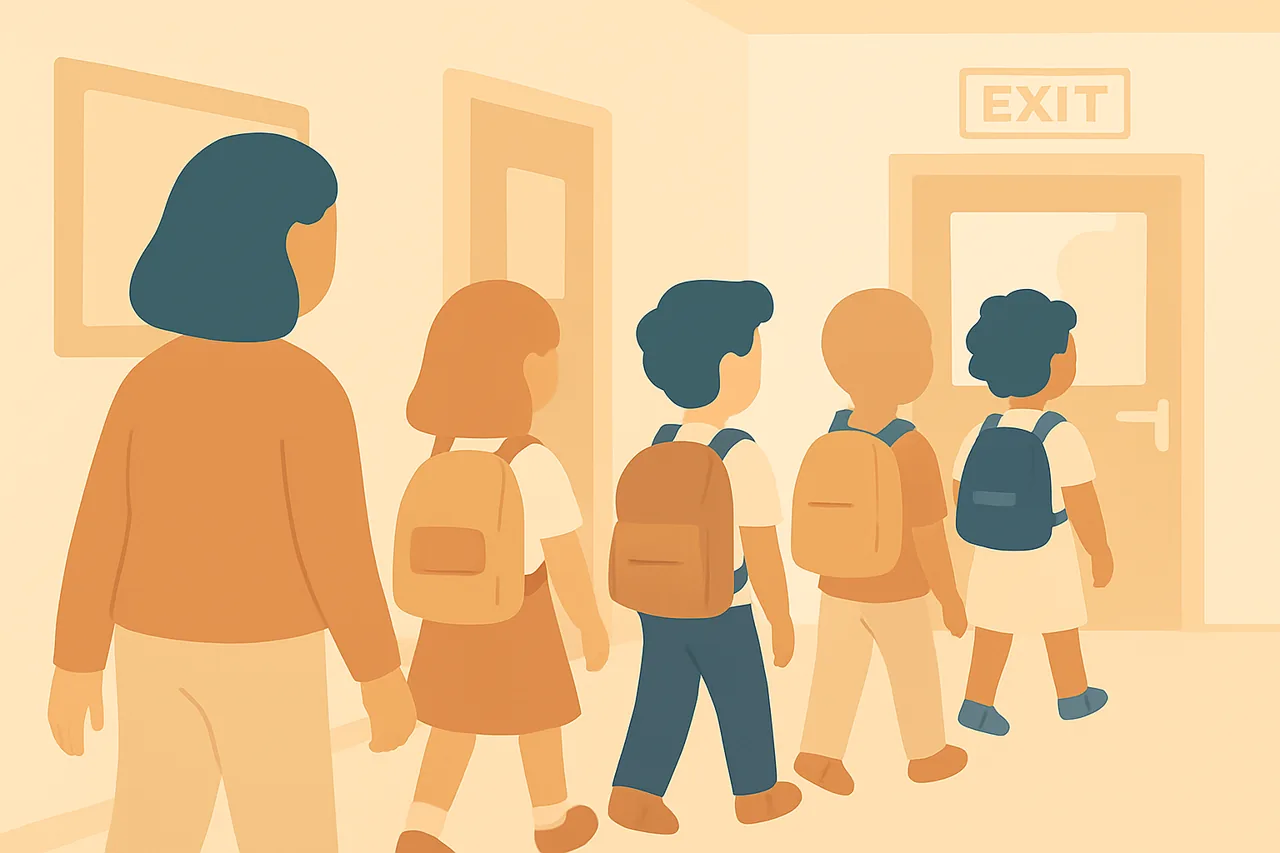
Why does a student melt down coming home instead of during the outing?
The outing is often held together by novelty, structure, and hard coping effort. Coming home releases that effort all at once, and the move from a high-stimulation place back to the quiet of home is its own transition. Many stores, dentist visits, and playgrounds have a clear beginning and end. Home does not, so the student has no script for what "after" looks like. The coming-home story gives them one.
What pages does a coming-home social story need?
Keep it to four to six pages, one idea per page. The beats that matter for the coming-home transition specifically:
| Page | Beat | Sentence type |
|---|---|---|
| 1 | Naming the outing that is ending ("We went to the park") | Descriptive |
| 2 | The ride or walk home, and what the student sees on the way | Descriptive |
| 3 | How the student might feel (tired, wound up, sad it ended) | Perspective |
| 4 | Walking in the door and the first calm thing at home | Descriptive + one directive |
| 5 | What a grown-up will do to help | Cooperative |
| 6 | What comes next, so home has a shape ("After snack, quiet time") | Affirmative |
Notice there is one directive sentence in the whole story. Carol Gray methodology recommends at least two descriptive or perspective sentences for every directive. A coming-home story that reads as a list of "I will calm down" lines is closer to a behavior plan than a social story, and it usually backfires with a student who is already dysregulated.
What is a fill-in template I can reuse for any outing?
This is the "money quote" from the same 2024 survey: "I wish I had a template I could easily customize to change the pictures of the child or parents quickly but keep the same story." Coming-home is the perfect place for that, because the home pages never change. Only the outing changes.
Reusable scaffold (swap only the bracketed parts):
1. Today we went to [the park]. It was [fun and busy].
2. When it is time to go home, we get in the [car]. I can see [houses and trees] on the way.
3. Sometimes I feel [tired or upset] when a fun thing ends. That is okay.
4. When we get home, I can [sit in my cozy spot] first.
5. [Mom] will help me if I feel too big inside.
6. After I rest, it will be time for [snack]. Home is a calm place.
When should I read a coming-home story with the student?
Read it before the outing, and again in the car on the way home if you can, not during a meltdown. A social story primes; it is not an in-the-moment intervention. One school SLP put the practical version well: build the story so the coming-home routine is predictable, then re-read it on a regular schedule until it settles. Aim for two to three readings before the first real outing, then weekly until the pattern fades.
Does the research support using a story for transitions like this?
Yes, with honest limits. Social narratives are reviewed as an evidence-based practice for autistic students by AFIRM and the National Clearinghouse on Autism Evidence and Practice, with transition support among the covered outcomes. A 2026 Frontiers in Psychology meta-analysis of 21 single-case studies found a moderate overall effect (Tau-U = 0.743), strongest for children 7 to 12, and found no significant difference based on who delivered the story or whether it was digital or paper. The 2024 ASSSIST-2 cluster randomized trial of 249 autistic children across 87 schools found the broad effect on global social skills was limited, but the stories reliably helped adults and students build a shared understanding of a hard situation. A coming-home story can reduce the intensity of the transition; it will not eliminate every meltdown.
From the same community threads on real photos: "Getting suitable pictures is 90 percent of the work." For a coming-home story, a photo of your student's actual front door and cozy spot does more than any clip art, because the whole point is helping them picture this home, not a generic one.
Frequently Asked Questions
Why does my student melt down after an outing, not during it?
The outing is often held together by novelty, structure, and effort to cope. Coming home releases that effort, and the shift from a high-stimulation setting back to the quiet of home is its own hard transition. A social story primes the student for the coming-home step specifically, which is the part most stories skip.
How long should a coming-home social story be for a K-5 student?
Four to six pages, roughly 8 to 12 sentences. One idea per page. Cover the car ride or walk home, walking in the door, the first calm activity at home, and what happens next. Keep at least 2 descriptive or perspective sentences for every directive sentence.
Should the story be read before or after the outing?
Read it before the outing, ideally in the car on the way home or right before you leave, not during the meltdown. A social story is a priming tool, not an in-the-moment behavior script. Re-read it on a regular schedule until the coming-home routine settles.
Can I reuse the same story for different outings?
Yes, if you build it as a template. Keep the coming-home pages the same and swap only the outing name and one or two details. Most SLPs and OTs rebuild the whole story each time, which is why so few coming-home stories get made. A reusable scaffold fixes that.
Is a coming-home social story evidence-based?
Social narratives are reviewed as an evidence-based practice for autistic students by AFIRM and the National Clearinghouse on Autism Evidence and Practice. Transition support is one of the outcomes the evidence covers. Effects are strongest when the story is specific, individualized, and re-read on a schedule.
What if the meltdown still happens after the story?
Treat the story as priming, not a cure. Pair it with a predictable first-at-home activity, a visual of what comes next, and time to decompress. If meltdowns continue, shorten the outing, add a transition object the student carries home, and track the pattern before you rewrite the story.
One approach for school SLPs and pediatric OTs short on time is to keep a 5-tool stack: a methodology checklist (the Gray ratio above), a reusable slide template with the home pages locked, a folder of the student's real photos sorted by setting, an AI text drafter (ChatGPT, Claude, MagicSchool, or Emoquest for one-sentence-in story output), and a delivery format your district already uses. The coming-home story does not need to be perfect. It needs to ship and be re-read before the next outing.