A K-5 dentist visit social story should be six to eight pages and cover the waiting room, the chair, the light, the mirror exam, the polish, the optional x-ray, the fluoride, and the sticker. The hardest pages are the polish and the suction sounds, both of which are common sensory triggers for autistic students. A 2026 systematic review and meta-analysis of non-pharmacological behavior guidance techniques sorted the options into five domains, including structured visual pedagogy (which is where social stories sit), video and virtual-reality modeling, systematic desensitization, and sensory-adapted environments. It found the strongest quantitative evidence for virtual reality, with visual supports and video modeling supported by more narrative and heterogeneous evidence. That is worth naming plainly: a dentist social story is a reasonable, low-cost preparation step, not the best-evidenced one. An earlier 2024 systematic review of 9 randomized controlled trials found video modeling and sensory-adapted dental environments produced significant reductions in anxiety and increased cooperation across sample sizes of 25 to 138 children with autism. In a 2024 Emoquest community survey of 16 parents, school SLPs, OTs, and SPED teachers, 94% reported spending 30 or more minutes on a single social story, and finding appropriate visuals was the slowest step. This article is the 15-minute scaffold most SLPs and pediatric OTs use.
Why are dentist visits especially hard for autistic K-5 students?
Five sensory events stack inside a 30-minute visit. The waiting room can be loud and have unfamiliar smells. The chair leans back unexpectedly. The bright overhead light is uncomfortable. The polishing tool buzzes and tastes like flavored paste. The suction makes a wet, surprising sound. Most autistic K-5 students are not avoiding the dentist, they are avoiding one or two of these specific events. Naming the events in the story lets the student prepare for each one in advance.
What does the dentist visit social story scaffold look like?
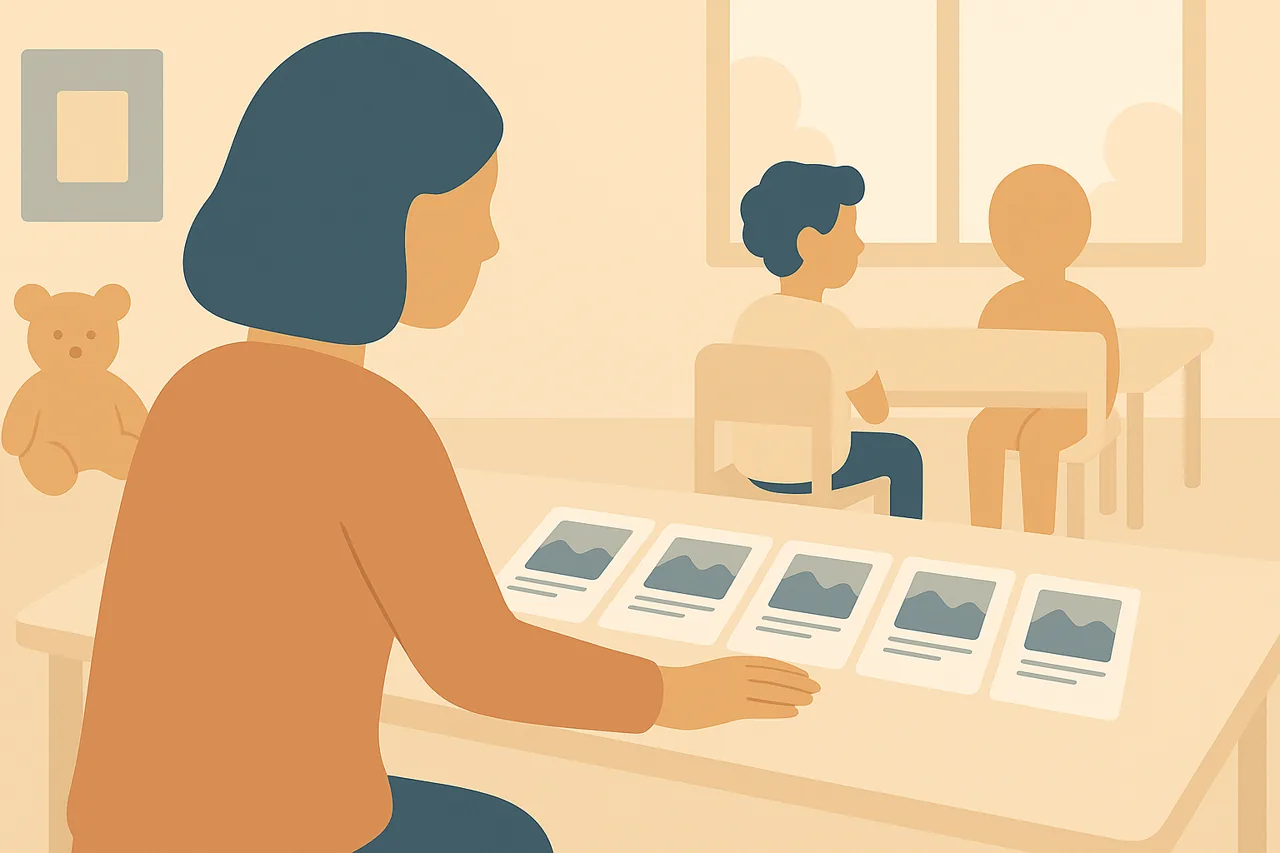
One page per beat. Aim for 2 descriptive or perspective sentences per page and at most 1 directive sentence in the whole story to stay inside AFIRM's social narrative methodology and Carol Gray's recommended ratio:
- Page 1: Why I am going. "Today I am going to the dentist. The dentist helps keep my teeth clean and healthy."
- Page 2: The waiting room. "When I get there, I sit in the waiting room with my grown-up. There are toys and a TV. Other kids and parents are waiting too."
- Page 3: The chair. "A hygienist takes me back to a special chair. The chair can lean back so the dentist can see my teeth."
- Page 4: The light and mirror. "A bright light shines on my mouth. The dentist uses a small mirror to look at all my teeth. I can wear sunglasses if I want."
- Page 5: The polish. "The polishing tool feels like a soft buzzing toothbrush. It cleans my teeth and uses flavored paste. I can pick bubblegum or mint or strawberry."
- Page 6: The suction. "The suction is a small straw that makes a buzzing sound. It takes the water and paste out of my mouth so I do not have to swallow."
- Page 7: Fluoride or x-ray (only if scheduled). "Sometimes the dentist puts a foamy fluoride on my teeth or takes a picture of my teeth with an x-ray. The foamy fluoride tastes sweet. The x-ray takes one second."
- Page 8: The end. "When the dentist is done, I get a sticker and a new toothbrush. My grown-up is proud of me. We can do something fun after."
Money quote from the same 2024 survey: "I wish I had a template I could easily customize to change the pictures of the child or parents quickly but keep the same story." The dentist story is the canonical scenario where this pain shows up; the scaffold above stays the same student to student, and only the pictures, name, and one or two sensory-specific lines need editing.
How do I check the Carol Gray sentence ratio on this story?
Count sentence types. The 8-page scaffold above runs roughly 16 sentences. A Gray-compliant version has at least 2 descriptive or perspective sentences for every directive sentence:
| Sentence type | Example in this story | Approximate count |
|---|---|---|
| Descriptive | "The chair can lean back so the dentist can see my teeth." | 8 to 10 |
| Perspective | "My grown-up is proud of me." | 2 to 3 |
| Cooperative | "The hygienist will help if I need a break." | 1 to 2 |
| Affirmative | "The dentist helps keep my teeth clean and healthy." | 1 to 2 |
| Directive | "I can wear sunglasses if I want." | 1 maximum |
If your story reads as a sequence of "I will" sentences, it is closer to a behavior plan than a social narrative. Swap two of those for descriptive or perspective sentences and the ratio comes back into compliance.
What pictures actually work for this story?
From the 2024 community survey: "Getting suitable pictures is 90 percent of the work." For dentist stories specifically, the three highest-leverage images are the actual waiting room (most pediatric offices will email a photo if you ask), the chair leaned back, and the polishing tool up close. Real photos beat clip art for K-2. If you cannot get real photos, generic pediatric dental office images of a child from behind or in profile (no face) generalize well. Avoid uncanny-valley line drawings of dentist tools because the buzz sound and the tool look are hard to disambiguate in simple drawings.
What is the 15-minute workflow for this story?
For a school SLP or pediatric OT who has a same-week dentist visit on a student's calendar:
- Minute 0 to 2. Write down the student's name, age, the appointment time, and one sensory profile note (loud noises, bright lights, taste sensitivities).
- Minute 2 to 5. Email the dental office for one waiting-room photo and one chair photo. Most offices respond same day.
- Minute 5 to 9. Drop the 8-page scaffold above into Google Slides. Replace student name, swap in the office photos, edit the polish flavor choices to match what the office offers.
- Minute 9 to 12. Audit for sentence ratio (table above) and any directive language that should be descriptive.
- Minute 12 to 15. Export to PDF for the binder and send a copy home so the family can read it the night before.
What does the evidence say about social narratives for dentist visits?
The 2025 AFIRM social narratives brief packet lists social narratives as an evidence-based practice for autistic learners ages 3 to 22, with outcomes including adaptive skills (which covers medical and dental cooperation). A 2024 meta-analysis in IJERPH on preschool social story interventions reported targeted behavioral improvements when stories were paired with positive reinforcement. The 2024 ASSSIST2 RCT reminded the field that fidelity matters: stories work better when families and schools follow the protocol (re-read multiple times, audit the ratio, do not improvise mid-event).
What about FERPA and sharing the story with the dentist's office?
Two rules. The story file lives in your district drive if you are a school SLP or pediatric OT. If you send the story to the dental office, send the PDF, not the editable Google Slides file, and use the student's first name only. The school relationship is FERPA-governed; the dentist relationship is the family's HIPAA-governed relationship. Keep your part inside FERPA boundaries and let the family decide what to share with the office.
Frequently Asked Questions
How many pages should a dentist visit social story be?
Six to eight pages for K-5, roughly 10 to 16 sentences total. One page per beat: waiting room, chair, light, mirror exam, polish, x-ray (if scheduled), fluoride, sticker and goodbye. Skip the x-ray page if the student is going for a routine cleaning that does not include it.
Should I include the suction or polishing tool sounds in the story?
Yes, name the sound and what makes it on its own page. The suction is the noisiest and most surprising sensory event. The story should describe it before the student hears it: "The suction is a small straw that makes a buzzing sound. It takes the water out of my mouth." Headphones and a stim toy are acceptable cooperative-sentence add-ons.
Can I use a real photo of the actual dentist office?
Yes, and it usually helps. Most pediatric dental offices will let a parent or SLP take photos of the waiting room and chair if you ask ahead. If photos are not possible, generic stock images of a pediatric dentist office work fine. Avoid line drawings for K-2 students who do not generalize well from abstract characters.
How early should I introduce the story before the appointment?
Read it the night before, the morning of, and one more time in the car or waiting room. For first-time dentist visits, start re-reading three to seven days ahead. The story is a priming tool, not an in-the-moment intervention, so the bulk of the work happens before the appointment.
What if my student refuses to open their mouth at the dentist?
Add an explicit choice page to the story: "I can show the dentist my teeth or I can ask for a break." Pediatric dentists are usually flexible and will count counting noises, watching first, or one-tool-at-a-time as wins. Co-write the story with the dentist's office ahead of time if you can.
Should the dentist story include the fluoride taste?
Yes if the student is sensitive to taste. Most pediatric offices offer flavored fluoride; the story can let the student preview the choice ("I can pick bubblegum or mint or strawberry"). Choice within the routine reduces refusal more than a stricter story does.
Can a pediatric OT write the dentist social story instead of the SLP?
Yes. Sensory-prep stories like dentist, haircut, and hospital fall naturally in pediatric OT scope. Many school SLPs and OTs co-write the dentist story because the SLP owns pragmatic language goals and the OT owns sensory-prep goals on the same student's IEP.
Is there research specifically on dental social stories for autistic children? (Updated June 2026)
Yes. The 2024 MDPI systematic review of social story interventions for preschool children found significant improvement in oral-care behaviors, including toothbrushing compliance, when stories were paired with conventional dental-prep methods. The takeaway: pair the dentist story with a 2-minute mock exam at school using a mirror and a toothbrush, not the story alone.
Do sensory-adapted dental environments matter as much as the story? (Updated July 2026)
Both matter, and they address different parts of the visit. A 2024 systematic review of 9 randomized controlled trials found that dimmed lights, reduced background noise, and calming music in the dental office itself, separate from the social story, produced significant reductions in anxiety and increases in cooperation across studies of 25 to 138 children with autism. If your student's dental office is willing to adjust the room, ask before the appointment. The story prepares the student for the visit; the environment adjustment reduces how much preparation has to do on its own.
Is a social story the best-evidenced way to prepare an autistic student for the dentist? (Added August 2026)
No, and it is worth being honest about that. A 2026 systematic review and meta-analysis of non-pharmacological behavior guidance techniques found the strongest quantitative evidence for virtual reality interventions, with structured visual supports and video modeling backed by more narrative and heterogeneous evidence. A social story is still the most practical option for most school SLPs and families, because it costs nothing and can be built in 15 minutes. Treat it as the accessible first step, and pair it with video modeling of the actual office if the family can get a clip.
One approach for school SLPs and pediatric OTs short on time is to keep a 5-tool stack: a methodology checklist (the Gray ratio table above), a slide template you reuse for sensory-prep scenarios (dentist, haircut, hospital, fire drill), a folder of stock photos sorted by scenario, an AI text drafter (ChatGPT, Claude, MagicSchool, or Emoquest for one-sentence-in story output), and a delivery format your district already uses. The dentist story is the one most worth keeping as a reusable template because half your caseload will need it at some point.