A fire drill social story for a K-5 autistic student should run 6 pages and cover, in order, the warning, the alarm, the line-up, the walk outside, the wait at the muster point, and the all-clear. A 2025 Frontiers in Psychiatry study validating the school-based "Facing Your Fears in Schools" CBT program for autistic students found significant anxiety reductions when staff combined psychoeducation, skills practice, and graded exposure, which is exactly what a fire drill social story is designed to deliver. In an Emoquest 2024 community survey of 16 parents, school SLPs, OTs, and SPED teachers, 94% reported spending 30 or more minutes writing a single social story, and fire drills are one of the scenarios mentioned most often as urgent and recurring. A 2024 multi-site cluster randomized trial, ASSSIST-2, of 249 autistic children across 87 schools found students using social stories met their individual socio-emotional goals significantly more often than peers in usual care, with a larger effect for students who used the story across six or more sessions. A 2026 Frontiers in Psychology meta-analysis of 21 studies puts a number on it: a moderate effect (Tau-U = 0.743), strongest for children aged 7 to 12, which covers most of the K-5 range you are writing this drill story for. A 2025 UK Fire Industry Association guidance document on alarms and sensory sensitivities makes the point most stories miss: school alarms are frequently set louder than regulation requires, and pairing advance warning with a lower or more predictable tone reduces distress without reducing safety. Ask your building about the setting before you blame the story.
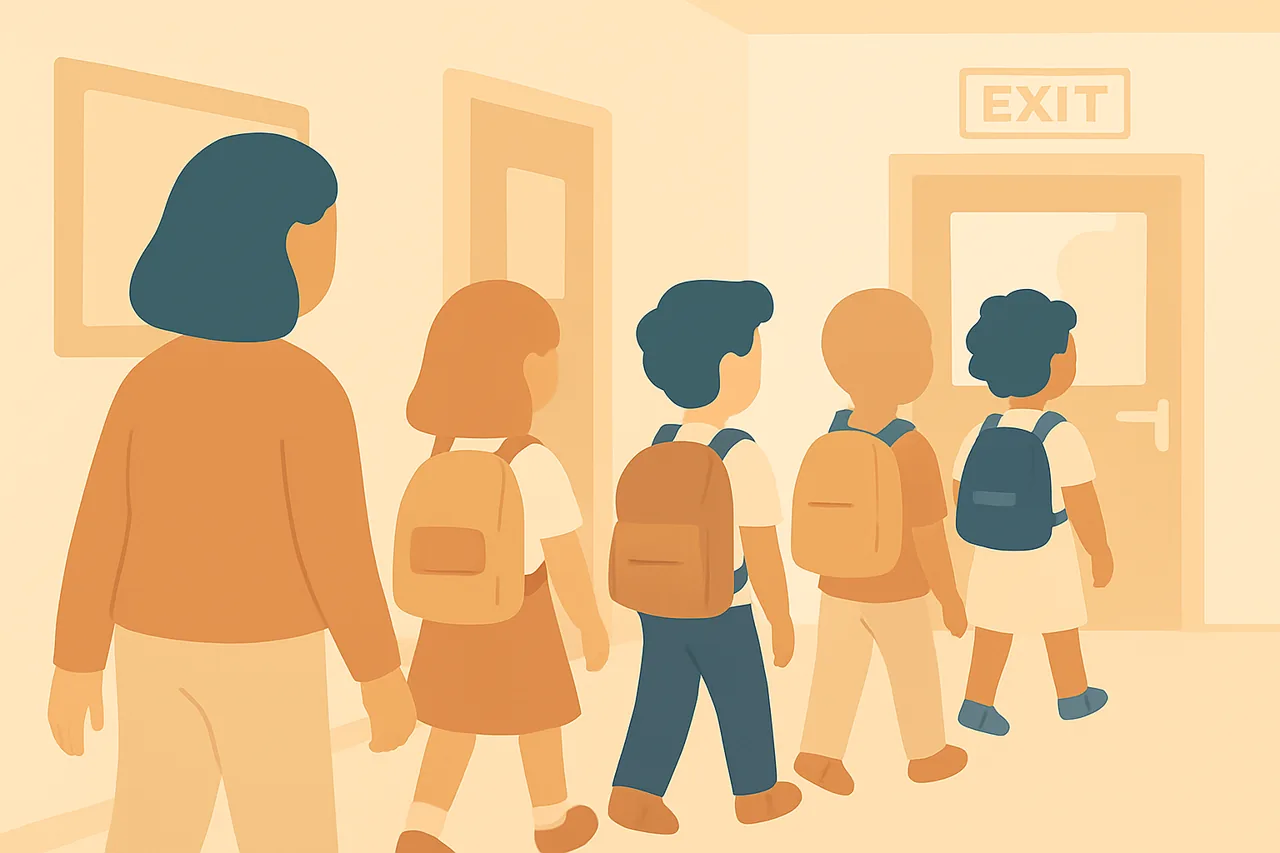
Why is a fire drill so hard for an autistic K-5 student?
Three things converge. The alarm is loud and unpredictable, between 85 and 110 decibels on most school systems. The routine breaks, which is its own stressor for many autistic students. And the physical movement is forced, with no choice about timing or pace. Safe and Sound Schools recommends advance warning, sensory accommodations, and rehearsal as the three pillars of a fire drill plan for autistic students. A social story is the rehearsal piece.
What should be on each of the 6 pages?
This is the page-by-page template most often used by school SLPs and pediatric OTs serving K-5 caseloads. Each page is 1 to 2 short sentences. The Carol Gray methodology ratio of at least 2 descriptive or perspective sentences for every 1 directive sentence is preserved.
| Page | Beat | Sentence type | Example |
|---|---|---|---|
| 1 | Warning | Descriptive | "Sometimes my school has a fire drill. A fire drill is a practice, not a real fire." |
| 2 | Alarm | Descriptive + perspective | "The alarm is very loud. Most students cover their ears. That is OK." |
| 3 | Line-up | Descriptive + cooperative | "My teacher will say 'line up.' She will help us walk to the door." |
| 4 | Walk outside | Descriptive + directive | "We walk quietly together. I can walk with my class." |
| 5 | Wait at the muster point | Descriptive + perspective | "Outside we stand together. My teacher will count to make sure we are all safe." |
| 6 | All-clear | Affirmative + cooperative | "When the drill is over, we walk back inside. I did a good job practicing." |
Money quote from the same Emoquest 2024 survey: "I wish I had a template I could easily customize to change the pictures of the child or parents quickly but keep the same story." Fire drills are the canonical example: every school has them, every autistic K-5 student needs one, and almost no template generalizes across the specific hallway, alarm, and muster point of your building.
How do you handle the noise without making it the whole story?
One descriptive sentence about the alarm being loud, paired with one cooperative sentence about what helps. Avoid making the alarm the centerpiece of the story or the student will fixate on it. The AFIRM social narratives module recommends matter-of-fact framing for sensory triggers: name the sensation, name a coping strategy, move on.
Practical noise plan to include in the story:
- Noise-reducing headphones stored at the student's desk or in the teacher's go-bag
- A specific person the student can stand next to (teacher, para, peer buddy)
- A visual signal that the alarm is "fake" (a small thumbs-up from the teacher)
What does the evidence say about social stories for school routines?
Social narratives are listed as an evidence-based practice by AFIRM and the National Clearinghouse on Autism Evidence and Practice (NCAEP). A 2024 randomized controlled trial in mainstream primary schools found social stories were cost-saving and maintained quality-adjusted life years compared to usual care. For a school SLP, the takeaway is that 30 minutes spent on a fire drill story is defensible time on the caseload.
How do you make the story FERPA-safe?
If you name the student or include a real photo, the file is an education record. Three rules cover most school cases. Store the file in your district-managed drive, not on a personal device. Use the student's first name only. Get written parent consent before using a real photo of the student in any version of the story that leaves your building.
How often should the student re-read the fire drill story?
Twice a week during the first month of school, then once a week, then once a month as a refresher. Always re-read it on the morning of a scheduled drill, and read it again any time the student is having a hard week (one good day after a hard week is when stories fade fastest). A 1-page summary card is appropriate once the full story has been read 8 to 10 times.
Frequently Asked Questions
How many pages should a fire drill social story be for a K-5 student?
Six pages for most K-5 students. One page each for warning, alarm, line-up, walk outside, wait at the muster point, and all-clear back inside. Cut to 4 pages for kindergarten by merging line-up and walk.
Do I need to warn the student before a fire drill?
When the building schedule allows, yes. Most school SLPs ask the front office for the drill date and time so the student can re-read the story that morning. If the drill is unannounced, the story still helps because the student has rehearsed the steps in advance.
How loud is the fire alarm and how do I prepare for it?
Most school fire alarms run between 85 and 110 decibels. For an autistic student with auditory sensitivity, plan for noise-reducing headphones or earplugs in the story. Show the student the headphones in the story art and have them stored where the student can reach them.
What should be in the story versus practiced in real life?
The story carries the sequence and the why. The practice carries the body memory. Pair a 2-minute re-read of the story with one walk-through of the evacuation route, ideally on a quiet day before the actual drill.
Can the same fire drill story work for kindergarten and fifth grade?
No. Kindergarten needs 1 short sentence per page and large pictures. Fifth grade can handle 2 sentences per page and a perspective sentence about how teachers stay calm to help students stay calm. Keep two versions, not one.
Is a fire drill social story FERPA-relevant?
If the file names a specific student or includes their photo, treat it as an education record under FERPA. Store the file in your district-managed drive, use first name only, and get written consent before using a real photo of the student.
Are social narratives evidence-based for fire drills specifically?
Social narratives are listed as an evidence-based practice by AFIRM and the National Clearinghouse on Autism Evidence and Practice (NCAEP). Fire drill stories are not a separately-studied subtype, but they are a textbook application of the broader social narratives evidence base.
Is there 2025 evidence that pairs social stories with anxiety reduction during fire drills? (Updated May 2026)
Yes. The 2025 Frontiers in Psychiatry study of "Facing Your Fears in Schools" (FYF-S) found that combining psychoeducation, skills practice, and graded exposure significantly reduced anxiety in autistic students compared to usual care. A fire drill social story is a low-cost form of graded exposure (the student rehearses each step before the live drill) and pairs well with FYF-S-style coping tools. Use the story to set up the steps and pair it with the student's existing calming tool (headphones, fidget, scripted self-talk).
How many times should we rehearse the fire drill story before the drill? (Updated June 2026)
Aim for several calm readings, not one. The 2024 ASSSIST-2 cluster randomized trial found a larger effect for autistic children who used their social story across at least six sessions. Read the fire drill story once a day in the week before a scheduled drill, and pair at least one reading with a quiet walk-through of the evacuation route.
Is a fire drill story effective for a 5-year-old, or only older students? (Updated July 2026)
It can help across K-5, though the strongest evidence is for older children. The 2026 Frontiers in Psychology meta-analysis found the effect was largest for children aged 7 to 12. For a kindergartner, lean harder on one clear picture per page and a read-aloud, and expect the rehearsal to matter as much as the words.
Can the alarm itself be changed, or is the story the only lever? (Updated August 2026)
The alarm is often adjustable. A 2025 Fire Industry Association guidance document on fire alarms and sensory sensitivities notes that school systems are commonly set well above the minimum required volume, and that slower, more predictable tones give autistic students more processing time than fast-changing ones. Bring it to your facilities lead alongside the story. Ear defenders, an advance heads-up, and a named adult cover the rest.
One approach for school SLPs short on time is to keep a 5-tool stack: a methodology checklist (the Carol Gray ratio rule), a slide template you reuse for the 6-page fire drill format, a folder of real photos of your specific building's hallway and muster point, an AI text drafter (ChatGPT, Claude, MagicSchool, or Emoquest for one-sentence-in story output), and a delivery format your district already uses (Google Slides or PDF). The fire drill story is the one you will rebuild for every new student. A reusable template makes that 5 minutes instead of an hour.