A personal-space social story works when it explains why space matters and gives one concrete thing to do with busy hands, not when it lists "I will not touch." The most common mistake is writing it as a rule, which reads like punishment and rarely sticks. It also helps to know what you are working against: a longitudinal study of personal space in autism found that autistic young people preferred consistently shorter interpersonal distances than their non-autistic peers, and that preference stayed stable across three years. This is a durable preference, not a phase you correct. In a 2024 community survey of 16 parents, school SLPs, OTs, and special educators, 94% reported spending 30 or more minutes on a single story, so this article gives you a reusable 6-page scaffold you can personalize fast.
Why do personal-space stories go wrong so often?
They go wrong because they are written as a list of "I will not" sentences. A story that reads "I will not hit. I will not grab. Hands are not for touching" is closer to a behavior plan than a Carol Gray methodology social story. It tells the student what to stop without naming what to do instead, and repeated readings of a corrective story can feel like a consequence rather than support. The fix is to describe the situation, name the feeling, and hand the student a concrete alternative.
What should a personal-space social story actually say?
Anchor it to what the student can do, and to how keeping space helps other people feel comfortable. Carol Gray methodology asks for at least two descriptive or perspective sentences for every directive sentence. A good perspective sentence for this topic is: "When someone stands very close, they might feel surprised or uncomfortable." A good cooperative sentence is: "My teacher will help me remember my space." One directive at most: "I can keep an arm's length of space."
What does a 6-page scaffold look like?
This scaffold covers the situation in six short pages. Swap the name, the setting, and the coping tool to personalize it for a specific student.
| Page | Purpose | Example sentence |
|---|---|---|
| 1 | Name the topic (descriptive) | "At school I am near other kids all day." |
| 2 | Define personal space (descriptive) | "Personal space is the room around a person, about an arm's length." |
| 3 | Others' feelings (perspective) | "When I stand very close or touch, a friend might feel surprised." |
| 4 | Name the urge (perspective) | "Sometimes I want to hug or tap a friend. That is a normal feeling." |
| 5 | Concrete alternative (directive + cooperative) | "I can hold my fidget or wave. My teacher can help me remember." |
| 6 | Positive close (affirmative) | "Keeping my space helps my friends feel comfortable. I can do it." |
How do you make "an arm's length" concrete for a K-5 student?
Abstract space is hard, so make it physical. Many school SLPs and OTs teach an arm's length as a "hula-hoop of space," or have the student stretch one arm toward a partner as a check. Pair the story with a floor marker, a taped square, or a hula hoop during practice so the words in the story map onto something the student can see and feel. Social narratives that add this kind of visual and rehearsal are reviewed as an evidence-based practice by AFIRM's social narratives module and the National Clearinghouse on Autism Evidence and Practice (NCAEP).
Money quote from the same 2024 survey: "I wish I had a template I could easily customize to change the pictures of the child or parents quickly but keep the same story." Personal space is a repeat request across a caseload, so a reusable scaffold you personalize per student is exactly the time-saver practitioners keep asking for.
How do you keep it FERPA-safe when the scene shows other kids?
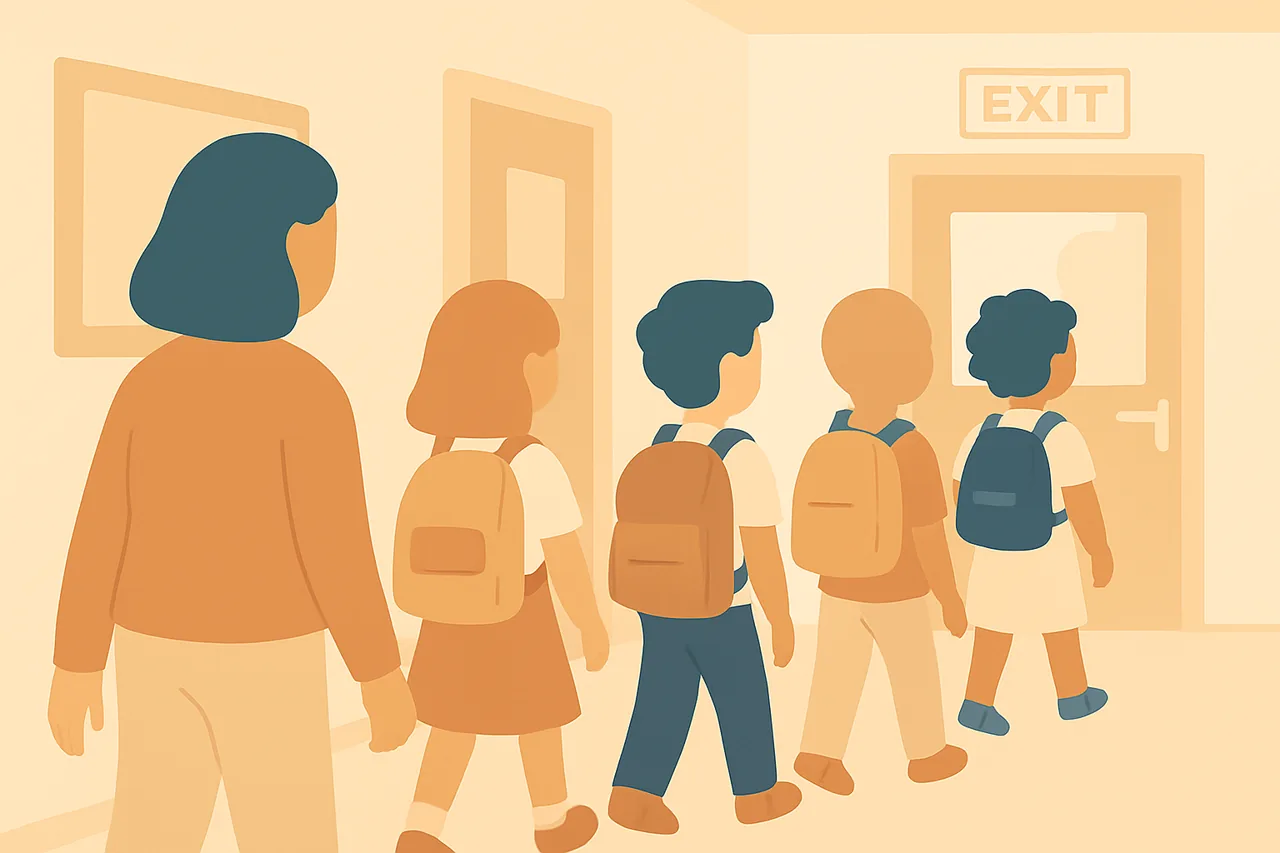
Personal-space scenes usually show a peer, which is where consent gets tricky. Two rules cover most cases: do not use a real photo of another identifiable student without that family's consent, and store any file with a student's name in your district-managed drive rather than a personal account. Illustrations or photos taken from behind, showing figures without faces, sidestep the consent problem and still generalize well for most K-5 students.
When should the student read it, and when do you fade it?
Read the story before the tricky setting, such as line-up, circle time, or partner work, not in the middle of a hands-on moment. Aim for two or three readings before the first real exposure, then re-read on a regular schedule. Once the student keeps space consistently, thin the readings out and keep the story on hand for a refresher after a long break.
Frequently Asked Questions
How do you write a social story about keeping hands to yourself?
Describe why personal space matters, name the feeling that leads to touching, and give one concrete thing the student can do with their hands instead. Avoid a page that only says "I will not touch." Replace it with a cooperative option like "I can hold a fidget" or "I can put my hands in my pockets."
How long should a personal-space social story be for a K-5 student?
Four to six pages, roughly 8 to 12 sentences. Long enough to explain what personal space is and what to do, short enough to read before recess or circle time. Keep at least 2 descriptive or perspective sentences for every directive sentence.
Should a personal-space story say "I will not hit or touch"?
No. A story that reads as "I will not hit" is closer to a behavior plan than a social story, and it can feel like punishment. Frame the story around what the student can do instead, and around how keeping space helps friends feel comfortable. The story is a priming tool, not a consequence.
What concrete alternatives can I give for busy hands?
Offer a small menu the student picks from: holding a fidget, putting hands in pockets, squeezing hands together, hugging a backpack, or giving a wave instead of a hug. A visual of an arm's length of space, sometimes taught as a hula-hoop of space, makes the abstract idea concrete.
When should the student read a personal-space social story?
Read it before the situation, not during a moment of dysregulation. Aim for 2 or 3 readings before the first tricky setting, such as line-up or partner work, then re-read on a schedule until the skill generalizes and you can fade it.
Should I use real photos or illustrations for a personal-space story?
Real photos of the actual setting help most K-2 students, but personal-space scenes often show other children, which raises consent and FERPA questions. Photos taken from behind or illustrations that show figures without faces are a safe alternative that still generalizes well.
Do autistic students naturally prefer standing closer than peers?
A longitudinal study of personal space in autism found that autistic young people preferred shorter interpersonal distances than non-autistic peers, and that the preference stayed stable across three years. Treat the story as teaching a school-specific expectation, not as correcting a defect. Say what the space is for, and give the student something concrete to do with their hands.
One approach for school SLPs and pediatric OTs short on time is to keep a 5-tool stack: a methodology checklist (the Gray ratio), a slide template you reuse, a folder of stock or faceless photos sorted by scenario, an AI text drafter (ChatGPT, Claude, MagicSchool, or Emoquest for one-sentence-in story output), and a delivery format your district already uses (Google Slides or PDF). Keep the 6-page personal-space scaffold above in that template folder so the next student only takes a few minutes.