Write a 6-page school assembly social story covering arrival, seat, why it gets loud, the noise plan (headphones first, break second), what to do if the noise crosses tolerance, and the end. Read it 3 to 5 days before the assembly, again the day before, and once the morning of. A 2025 study of parent-reported auditory hypersensitivity found roughly two thirds of autistic children show notable sound sensitivity, with stress and avoidance of noisy social settings as the common result, so plan the assembly story for sensory load first and behavior second. A 2022 Fire Industry Association guidance document on sound and sensory sensitivities found that predictable, gradually building sound is measurably less distressing than a sudden burst, which is why the story below includes an advance verbal cue for the loudest moment, not just a seat and headphones. In the Emoquest 2024 community survey of 16 parents and school staff, 94 percent reported spending 30 or more minutes on a single social story, so use the page-by-page template below and keep it for reuse across every assembly this year.
Why does a school assembly need its own social story?
Assemblies combine three triggers in one hour: unfamiliar adults on a stage, a crowd in a non-classroom space, and intermittent loud noise from clapping, cheering, music, or a microphone. The crowd density and acoustics of a gym or auditorium push peak sound levels into the 80 to 100 decibel range, which is high enough to cause auditory overload for many autistic K-5 students. Social narratives are listed as an evidence-based practice for autistic learners by AFIRM and the National Clearinghouse on Autism Evidence and Practice (NCAEP), and a 2024 systematic review of social story interventions for preschool and elementary children in MDPI's International Journal of Environmental Research and Public Health found the strongest effects when stories are paired with concrete environmental accommodations like seating choice and sensory supports.
What does a 6-page assembly story look like?
A page-by-page template you can reuse for every assembly this year. Replace the bracketed text with student-specific detail.
| Page | Sentence type | Sample sentence |
|---|---|---|
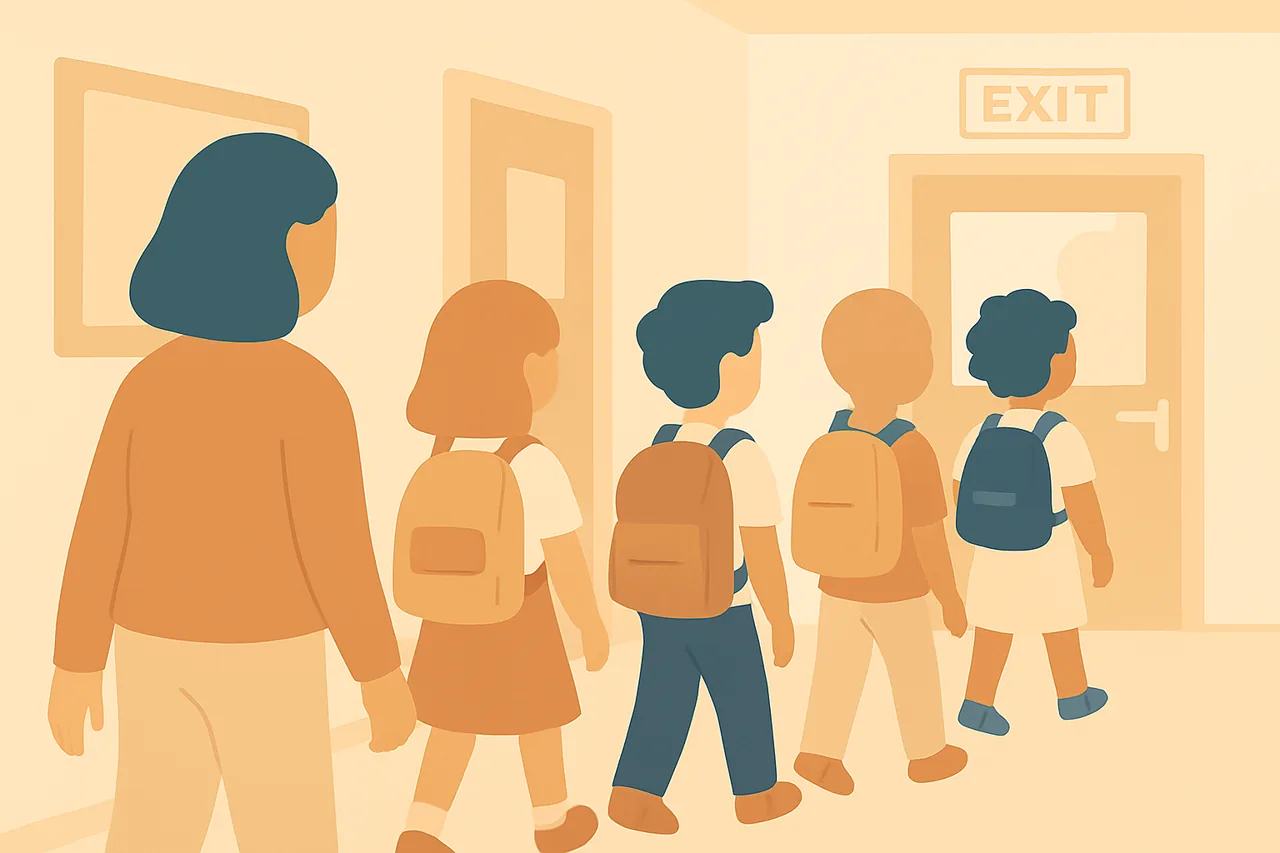
| 1. Arrival | Descriptive | Sometimes my class walks to the gym for an assembly. We line up by the door and walk together. |
| 2. Seat | Descriptive + Cooperative | I sit at the end of the row near [exit name]. My teacher knows this is my seat. |
| 3. Why it gets loud | Perspective | People clap and cheer to show they are excited. The clapping can sound very loud because the gym makes sound bounce. |
| 4. Noise plan | Control + Cooperative | If it feels too loud, I can put on my headphones. My headphones are in my [bag or pocket]. |
| 5. If headphones are not enough | Control + Cooperative | If it still feels too loud, I can take a quiet break in the hallway. My teacher will come with me. I can come back when I am ready. |
| 6. End | Descriptive + Affirmative | When the assembly is over, my class walks back to the classroom. I did my noise plan. |
What does the Carol Gray sentence ratio look like for this story?
Six pages, roughly 10 to 12 sentences total. The 2:1 descriptive-to-directive ratio means at most 1 explicit directive sentence in the whole story. In the template above, no page is a list of "I will" commands. The closest are the cooperative sentences in pages 2 and 5, which describe what the teacher will do alongside the student. That is the Gray-compliant pattern: the story describes the situation, the student keeps the control.
How do you handle the noise piece specifically?
Three concrete moves school SLPs use, in order:
- Pre-store the headphones. Headphones in a hallway locker or front-office drawer do not help when the assembly starts in 90 seconds. Store them on the student or in the classroom go-bag.
- Name the seat. "End of row near the side exit." A named seat lets the student rehearse the walk during the pre-read.
- Make the break a step, not a failure. Page 5 frames the hallway break as a continuation of the noise plan, not as leaving. The student stays in control of returning.
From the same 2024 Emoquest community survey: "Getting suitable pictures is 90 percent of the work." For an assembly story, the pictures that earn their keep are: the gym from the student's eye level, the assigned seat, the headphones, and the quiet-break spot in the hallway. Use those four photos in every assembly story you write this year. Swap only the cover photo and the assembly topic.
How early should you read the story with the student?
The pattern most school SLPs in r/slp describe:
- 3 to 5 days before, first read. Walk through each page slowly.
- 1 day before, second read. Pair with a quick walk past the gym so the room is fresh.
- Morning of, third read. 2 to 3 minutes, mostly the noise plan.
- Right before lining up, optional fourth read. Just pages 4 and 5 (the noise plan).
For a surprise assembly the schedule collapses. Read pages 4 and 5 while walking to the gym, hand the headphones to the student before entering, and seat them at the end of the row. The pre-rehearsed steps do most of the work.
What does the research say about this kind of accommodation?
The 2024 ASSSIST-2 cluster randomised controlled trial in UK primary schools found that personalised social stories improved individual social-emotional goal attainment but did not significantly improve broad measures of social responsiveness or anxiety. The takeaway for an assembly story: write the story around one concrete goal ("stays in the assembly for 20 minutes with headphones") instead of a broad one ("feels calm at assemblies"). The narrow, measurable goal is the one the evidence base supports.
FERPA-safe storage of the assembly story
If the file names the student or includes their photo, treat it as an education record under FERPA. Store it in the district-managed drive, use the student's first name only, and get written consent before using a real photo of the student. For pictures of the gym, the seat, and the headphones, no consent is needed because no student is identifiable in those photos.
Frequently Asked Questions
How long should a school assembly social story be?
Six pages for most K-5 students: arrival, seat, why it gets loud, the noise plan, what to do if it is too loud, and the end. Cut to 4 pages for kindergarten by merging arrival and seat, and merging the noise plan with what to do if it is too loud.
How loud is a typical school assembly?
Most gym or auditorium assemblies peak between 80 and 100 decibels during clapping, cheering, or music. That is loud enough to cause auditory overload for many autistic students. Plan for noise-reducing headphones or earplugs in the story and have them stored where the student can reach them without asking.
Should the student sit in a specific seat?
Yes. Most school SLPs recommend an end-of-row seat near a quiet exit. The story should name the seat by location so the student can rehearse walking to it. If the school does not allow assigned seats, write the story around "I sit at the end of the row" as the rule, not a specific spot.
What is a noise plan and how does it go in the story?
A noise plan is one or two concrete steps the student takes when sound crosses their tolerance. Most plans are: put on the headphones, then take a break if the headphones are not enough. The story names the steps in order so the student does not have to decide in the moment.
When should I read the assembly story with the student?
Read it 3 to 5 days before the assembly, again the day before, and once more the morning of. For a surprise assembly, read it as soon as you hear, and seat the student at the end of the row so the noise plan can run. Reading mid-assembly is usually too late.
Is leaving the assembly early always the right answer?
No. Build the story so leaving is a step, not the goal. Most assembly stories include "I can take a break in the hallway" as one option, and "I can come back when I am ready" as the partner. The point is the student stays in control of staying or leaving.
Can the same assembly story be reused for different assemblies?
Yes for the spine (pages 1, 2, 4, 5, 6). Swap page 3 (why it gets loud) and the cover for each assembly topic, whether that is a guest speaker, a pep rally, a band performance, or an awards ceremony. Reusing the spine is the single biggest time-saver an SLP gets from a good assembly template.
Does a sudden loud sound matter more than the overall volume? (Updated July 2026)
Yes. A 2022 Fire Industry Association guidance document on sensory sensitivities found that predictable, gradually building sound registers as less distressing than a sudden burst at the same volume, even though both are alarming. For an assembly story, this supports adding an advance verbal cue before the loudest moment (an MC saying "get ready to cheer" before the crowd does), not just a seat and headphones. Ask the assembly organizer if a heads-up announcement is possible before the loudest planned moment.
How common is sound sensitivity in autistic students? (Updated August 2026)
Common enough to assume it until you rule it out. A 2025 study of parent-reported auditory hypersensitivity found roughly two thirds of autistic children showed notable sound sensitivity, often leading to stress and avoidance of noisy social situations. A 2026 Frontiers in Psychiatry review put sensory hypersensitivity broadly at 70 to 90 percent, with sound among the most affected channels. For a whole-school assembly, that means the noise plan is the core of the story, not an add-on.
One approach for school SLPs short on time is to keep a 5-tool stack: a methodology checklist (Gray sentence ratios), a 6-page assembly template you reuse, a folder of stock photos (gym, end-of-row seat, headphones, quiet hallway), an AI text drafter (ChatGPT, Claude, MagicSchool, or Emoquest for one-sentence-in story output), and a noise plan card you can hand to the classroom teacher. The story does the prep. The seat and the headphones do the rest.