A social story for sharing and taking turns works best when it names the exact moment your student struggles: grabbing the four-square ball, cutting the line, or refusing to pass the classroom iPad. Show what waiting looks like second by second, not just the rule "we share." In a 2024 community survey of 16 parents, school SLPs, OTs, and special educators, 94% reported spending 30 or more minutes on a single social story. With a reusable scaffold, a turn-taking story takes about 10 minutes.
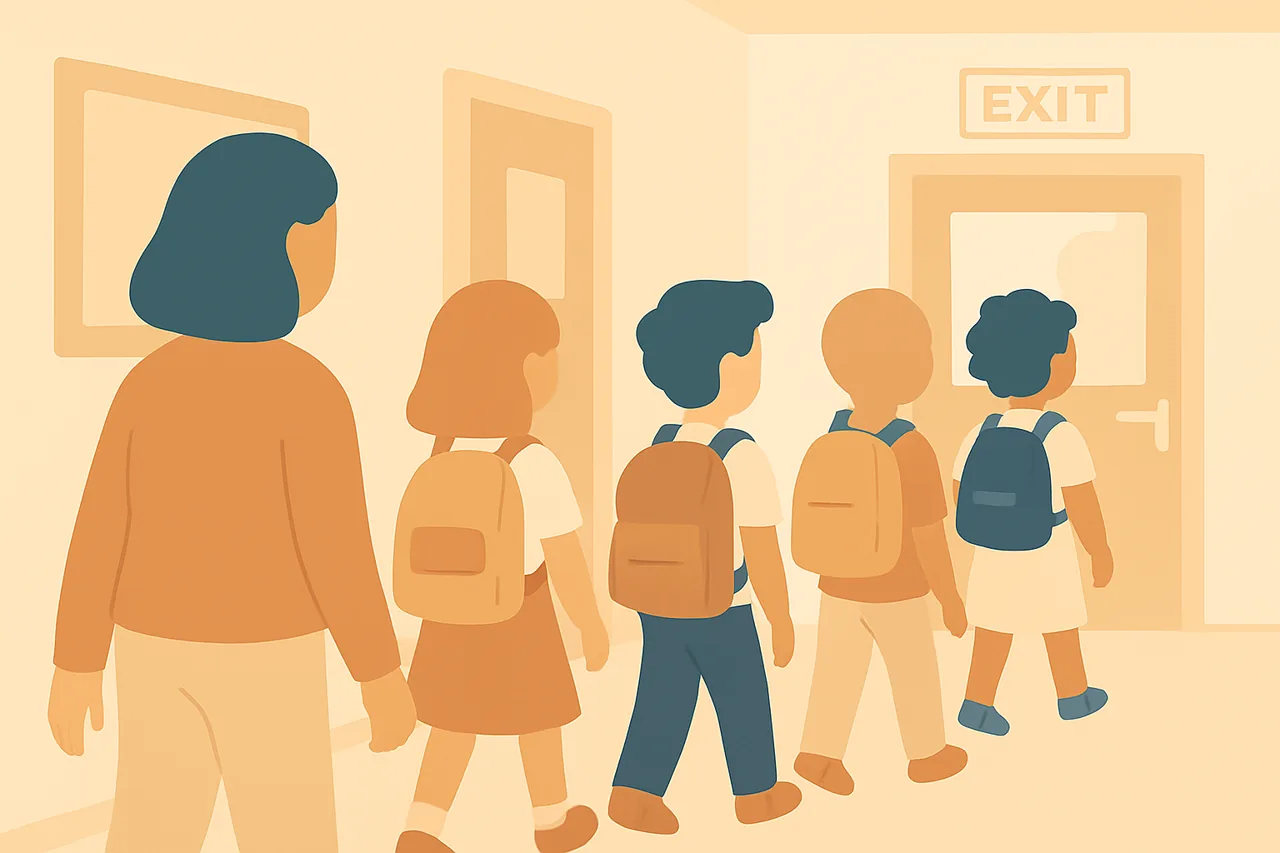
Why does sharing and taking turns need its own social story?
Because sharing is not one skill, it is three: waiting, giving up something you want right now, and trusting you will get a turn back. Most grabbing at recess or center time is a breakdown in the middle step. A story that only says "I will share" skips the part your student cannot do yet, which is tolerate the wait. Write the wait, and you write the story that actually primes the behavior.
What should a sharing and taking-turns social story actually say?
Build it one beat per page. This is the scaffold most school SLPs reuse across students, swapping only the object and setting:
| Page | Beat | Example sentence |
|---|---|---|
| 1 | What a turn is (descriptive) | At recess, my class takes turns with the four-square ball. |
| 2 | What waiting looks like (descriptive) | When it is not my turn, I stand near the line and watch. |
| 3 | How the other student feels (perspective) | My friend feels happy when they get to finish their turn. |
| 4 | What I can do while I wait (control) | When I want a turn, I can count to ten in my head. |
| 5 | How I get my turn back (descriptive) | Usually, the line moves and soon it is my turn again. |
| 6 | One gentle directive | I will try to wait for my turn. |
Notice there is one directive sentence in the whole story. Everything else describes what happens or how someone feels. That is the difference between a social story and a rules poster.
How do you keep it Carol Gray compliant, not a list of rules?
Hold the 2:1 ratio: at least two descriptive or perspective sentences for every one directive sentence. Social narratives are reviewed as an evidence-based practice for autistic students by AFIRM and the National Clearinghouse on Autism Evidence and Practice (NCAEP), and the ratio is what keeps the intervention working as designed. If your draft reads "I will wait, I will share, I will be nice," it has crossed into behavior-plan territory. Add sentences that describe the setting and the other student's feelings until the balance is right.
What scenario variations do K-5 students actually need?
The scaffold stays the same. Only the object and setting change. Keep a short menu so you are not rebuilding from scratch each time:
| Setting | What they share | The hard moment to write |
|---|---|---|
| Recess | Four-square ball, swings, jump rope | Waiting in line without cutting |
| Centers | Blocks, manipulatives, sensory bin | Giving up a preferred item when the timer rings |
| Technology time | Classroom iPad or computer | Handing the device to the next student |
| Group work | Markers, glue, one worksheet | Letting a partner have a turn to write |
| Board or card game | Dice, spinner, game pieces | Waiting through other players' turns |
Money quote from the same 2024 survey: "I wish I had a template I could easily customize to change the pictures of the child or parents quickly but keep the same story." Turn-taking is the clearest case for a reusable scaffold: the sentences barely change from student to student, but the object, the setting, and the photo do.
How do you know the sharing social story is working?
Pick one measurable behavior before you write, such as grabs per center rotation or prompts to wait at recess, and count it. Then re-read the story before the activity on a schedule, not once. In the 2024 multi-site cluster randomized trial ASSSIST-2 of 249 autistic children across 87 schools, students met their individual socio-emotional goals more often than peers in usual care, and the benefit grew with more sessions. A recent 2026 Frontiers in Psychology meta-analysis of 21 studies reported a moderate effect (Tau-U = 0.743), strongest for students aged 7 to 12, and found the format (digital or printed) mattered less than whether the story was specific and re-read.
Frequently Asked Questions
How long should a sharing and taking-turns social story be for a K-5 student?
Four to six pages, roughly 8 to 12 sentences. One page per beat: what a turn is, what waiting looks like, how the other student feels, what you can do while you wait, and how you get your turn back. Keep it short enough to read before recess or center time.
Should the social story name the specific toy or activity?
Yes. A story that says the four-square ball, the classroom iPad, or the blue blocks generalizes better than a story that says "toys." Name the exact object and setting where your student struggles, because that is the moment the story has to prime.
How do I keep it from sounding like a list of rules?
Keep the Carol Gray ratio of at least 2 descriptive or perspective sentences for every 1 directive sentence. If the story is mostly "I will wait" and "I will share," it reads as a behavior plan. Add sentences that describe what happens and how the other student feels.
What is a control sentence for taking turns?
A control sentence is the student's own reminder strategy, written in their words. For turn-taking it might be: "When I want a turn, I can count to ten in my head." It gives the student a concrete thing to do with the wait, which is the hardest part of sharing.
Does taking turns work for a whole class or just one student?
A fully Carol Gray compliant story is written for one student's perspective. A class-wide version is a social narrative or a script: same descriptive-to-directive balance, no personal pronouns. Many SLPs run one shared narrative at circle time and a personalized story for the student on the IEP goal.
How do I know the sharing social story is working?
Track the specific behavior you wrote the story for, such as grabs per center rotation, and re-read the story before that activity on a set schedule. In the 2024 ASSSIST-2 trial, benefit grew with more sessions, so a story read once rarely moves a behavior. Fade once the behavior generalizes.
One approach for school SLPs short on time is to keep a 5-tool stack: a methodology checklist (the 2:1 ratio and the beat scaffold above), a slide template you reuse for every turn-taking story, a folder of stock photos sorted by setting (recess, centers, technology), an AI text drafter (ChatGPT, Claude, MagicSchool, or Emoquest for one-sentence-in story output), and a delivery format your district already uses (Google Slides or PDF). The story does not need to be perfect. It needs to name the hard moment and get re-read.