Classroom transitions are the most-cited meltdown trigger for autistic K-5 students in school SLP and special-ed forums. The most reliable workflow is a 4 to 6 page personalized social story, paired with a visual schedule and a 2-minute warning timer. In a 2024 Emoquest community survey of 16 parents, school SLPs, OTs, and special educators, 94% reported spending 30 or more minutes writing a single social story, and the transition story is usually the one rewritten most often as the year progresses. A 2024 scoping review indexed in PMC found social stories most reliably shift behavior when the routine and timing stay consistent, which is why the schedule and timer matter as much as the words. The VCU Autism Center's May 2025 visual supports guidance makes the same point from the other direction: pair the advance warning with something the student can see, such as a countdown timer or a first/then board, rather than delivering it verbally alone.
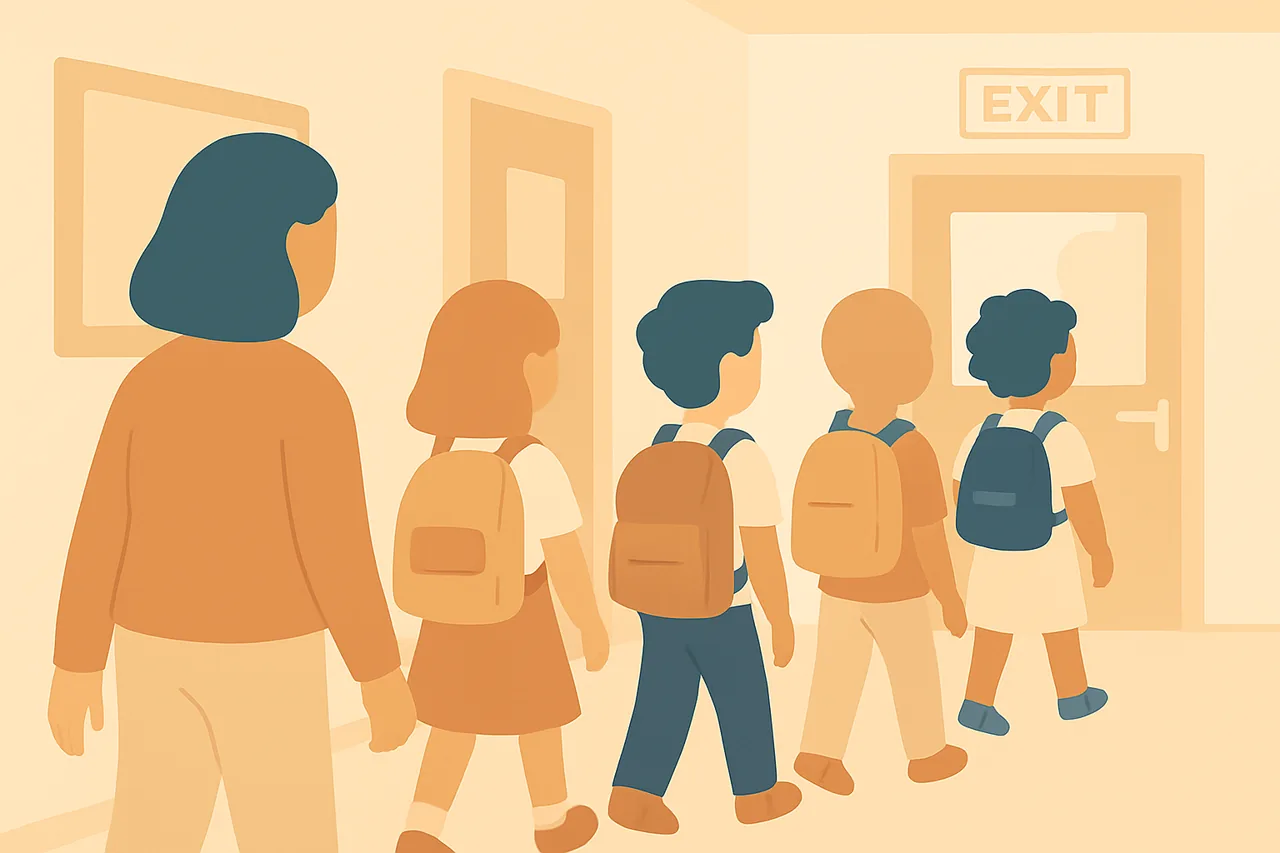
Why are classroom transitions so hard for autistic K-5 students?
Transitions stack three triggers at once: the loss of a preferred activity, the unknown of what is next, and a sensory shift (the room gets louder, the lights change, bodies start moving). For many autistic students that combination produces dysregulation faster than any single trigger would. A 2026 Frontiers in Psychology meta-analysis of 21 social story single-case studies (61 participants) found a moderate overall effect (Tau-U = 0.743), strongest for school-aged children 7 to 12, with significant effects on social skills and problem behavior reduction. Transition-targeted stories show up in the strongest-effect cluster.
What does a Carol Gray compliant transition story look like?
Carol Gray's methodology (the 10 defining criteria) requires at least 2 descriptive, perspective, or affirmative sentences for every directive sentence. For a transition story that means most of the page count is describing what is happening, how others feel, and what the room looks like, not telling the student what to do. A 4 to 6 page structure that works for most K-5 transitions:
| Page | What it covers | Example sentence type |
|---|---|---|
| 1 | The preferred activity (what the student is leaving) | Descriptive: "In math, I work on problems with Mr. Jones." |
| 2 | The signal that the transition is coming | Descriptive: "Mr. Jones says 'two minutes' and I see the timer turn red." |
| 3 | How transitions can feel | Perspective: "Sometimes ending math feels hard because I am not done." |
| 4 | What I can do to help myself | Control: "I can take three slow breaths while I close my book." |
| 5 | What is next and who helps | Cooperative: "Ms. Lee will meet me at the door and walk with me to PE." |
| 6 | How the next activity ends (closing the loop) | Affirmative: "When PE ends, I will come back and finish my math at my own pace." |
This is 5 non-directive sentences and 1 control sentence, well over the 2:1 minimum. Notice page 4 uses a control sentence ("I can take three slow breaths") instead of a directive ("I will calm down"). Control sentences hand the regulation tool back to the student instead of telling them what to do.
What is the 10-minute SLP workflow for a transition story?
A draft-from-scratch workflow that several school SLPs in r/slp describe using when they have to turn a transition story around the same day:
- Minute 0 to 2. Write the specific transition in one sentence, the student's name, age, and sensory profile (noise sensitive, slow processor, special interest).
- Minute 2 to 4. Outline the 6 page beats from the table above. Fill in the actual teacher names, room names, and routines.
- Minute 4 to 7. Draft the sentences. Aim for 1 to 2 sentences per page max. Keep at least one perspective sentence ("how it feels") and one control sentence ("what I can do").
- Minute 7 to 9. Drop in photos or icons. Real photos of the actual classrooms, hallway, and doorway beat clip art for K-2. Photo of the timer counts.
- Minute 9 to 10. Audit. Read once for the 2:1 ratio, once for student-specific vocabulary, once for anything that reads as punishment ("I will not yell"). Replace punitive lines with cooperative lines ("Ms. Lee will help me when I feel stuck").
How do you deliver the story so it actually works?
The story alone does about 30 to 40 percent of the work. The other 60 percent is in the delivery schedule and what surrounds it:
- 2 to 3 readings before the first real exposure (a day or two ahead). This is the priming pass.
- 1 brief re-read the morning of the transition day, especially for novel transitions (new specials teacher, a substitute, schedule change).
- A 2-minute warning before the transition itself, either spoken or via a visible timer. The 2024 ASSSIST2 RCT (n=249 UK primary students, see the NIHR HSDR report) found social story effects were strongest when paired with consistent in-classroom routines.
- A visual schedule on the wall showing the day's blocks, so the story is reinforced silently every time the student glances over.
- Re-read on a schedule (weekly is typical) until the behavior generalizes, then fade.
From the 2024 Emoquest survey: "Getting suitable pictures is 90% of the work." For a transition story, take 5 real photos in one walk-through (the preferred activity, the timer, the hallway, the doorway of the next room, the adult who walks with the student). One photo set covers half the school year of transition stories.
What about FERPA and a student's photo in the story?
Schools fall under FERPA, not HIPAA. Two rules cover most cases: treat the student's photo as an educational record (store the file in your district-managed drive, get written consent for use in any shared materials), and do not upload the student's first-and-last name with their photo into a general consumer AI tool until the district has signed a data privacy agreement for that specific tool. For the draft stage, use stock photos of similar-age students or photos of the student from behind. Swap in identifying photos only after consent and only in the final district-stored file.
Common mistakes school SLPs make on transition stories
The five patterns that show up most:
- One story per transition. Often the student needs one general transition story plus one or two targeted stories for the hardest transitions. Writing a new story for every single transition burns the SLP out.
- Directive-heavy ratio. "I will line up. I will be quiet. I will walk." reads as a behavior plan, not a Gray story. Cap directive sentences at 1 per story.
- No perspective sentence. Without "Sometimes ending math feels hard" the story loses the theory-of-mind work that builds self-awareness over time.
- Reading during the meltdown. The story is a priming tool. Trying to read it while the student is dysregulated rarely lands; the student associates the story with the meltdown.
- Never fading. Without a fade plan the story stays in rotation for years and stops working. Build a fade trigger (for example, 5 successful transitions in a row) into the IEP note from the start.
Frequently Asked Questions
Why are classroom transitions so hard for autistic K-5 students?
Transitions stack three triggers at once: the loss of a preferred activity, the unknown of what is next, and the sensory shift (noise, lights, movement). For many autistic students this combination produces dysregulation faster than any single trigger would.
What length works best for a transition social story?
4 to 6 pages, 8 to 12 sentences total. Long enough to cover the trigger, the sequence, the feelings, and one self-regulation move. Short enough that the student can read it in under 2 minutes.
Do I need a different story for every transition, or can one cover all of them?
Usually one general transition story plus targeted stories for the 2 to 3 hardest specific transitions. The general story covers the meta-skill (any transition follows roughly the same pattern). The targeted stories cover the specific sensory and routine details of the hardest ones.
How early should I read the story before the transition?
Read the story 2 to 3 times before the first real exposure (a day or two ahead), then re-read briefly the morning of and 2 minutes before the actual transition. Reading during the meltdown is too late; the story is a priming tool, not an in-the-moment intervention.
Should I pair the story with a visual schedule or timer?
Yes. The combination most school SLPs report works best is social story (the why and how) plus visual schedule (the what is next) plus a 2-minute audible or visual countdown timer. The story alone is 30 to 40 percent of the result. The schedule and timer carry the rest.
Does newer research support pairing the story with a fixed routine? (Updated June 2026)
Yes. A 2024 scoping review indexed in PMC found the most consistent behavior gains came when the story ran inside a stable, repeated routine rather than as a one-off. For transitions that means the same visual schedule, the same 2-minute warning, and the same adult, every day. Consistency is the active ingredient.
When do I fade out the story?
When the student successfully completes the transition without prompting on 4 to 5 consecutive school days, drop one re-reading per week until the story is read only weekly, then only when a routine changes. Keep the visual schedule and timer in place longer; they are easier to fade later.
Should the transition warning be spoken or visual? (Updated July 2026)
Both, with the visual as the anchor. The VCU Autism Center's May 2025 visual supports guidance recommends pairing advance transition warnings with something the student can see, such as a countdown timer, a first/then board, or a visual schedule, rather than relying on a verbal "2 more minutes" alone. A spoken warning disappears the moment it is said, and a student mid-activity may not have processed it.
One approach for school SLPs short on time is to keep a 5-tool stack: a 6-page transition story template you reuse for every student, a reusable icon set for the matching visual schedule, a folder of real photos of the school's hallways and specials rooms taken once at the start of the year, an AI text drafter (ChatGPT, Claude, MagicSchool, or Emoquest for one-sentence-in story output with Carol Gray ratio scaffolding), and a 2-minute timer (Time Timer, visual phone timer, or a classroom clock with a colored magnet). The story ships and gets re-read. The transition slowly stops being a meltdown.