A hallway social story works when it names the sensory load first and the rule second. Most fail by opening with "I walk quietly," a rule the student already knows. Write five to six pages describing the noise, the crowd, the turn, and the destination, then one directive sentence. In a 2024 survey of 16 SLPs, OTs, teachers, and parents, 94% spent 30 or more minutes per story.
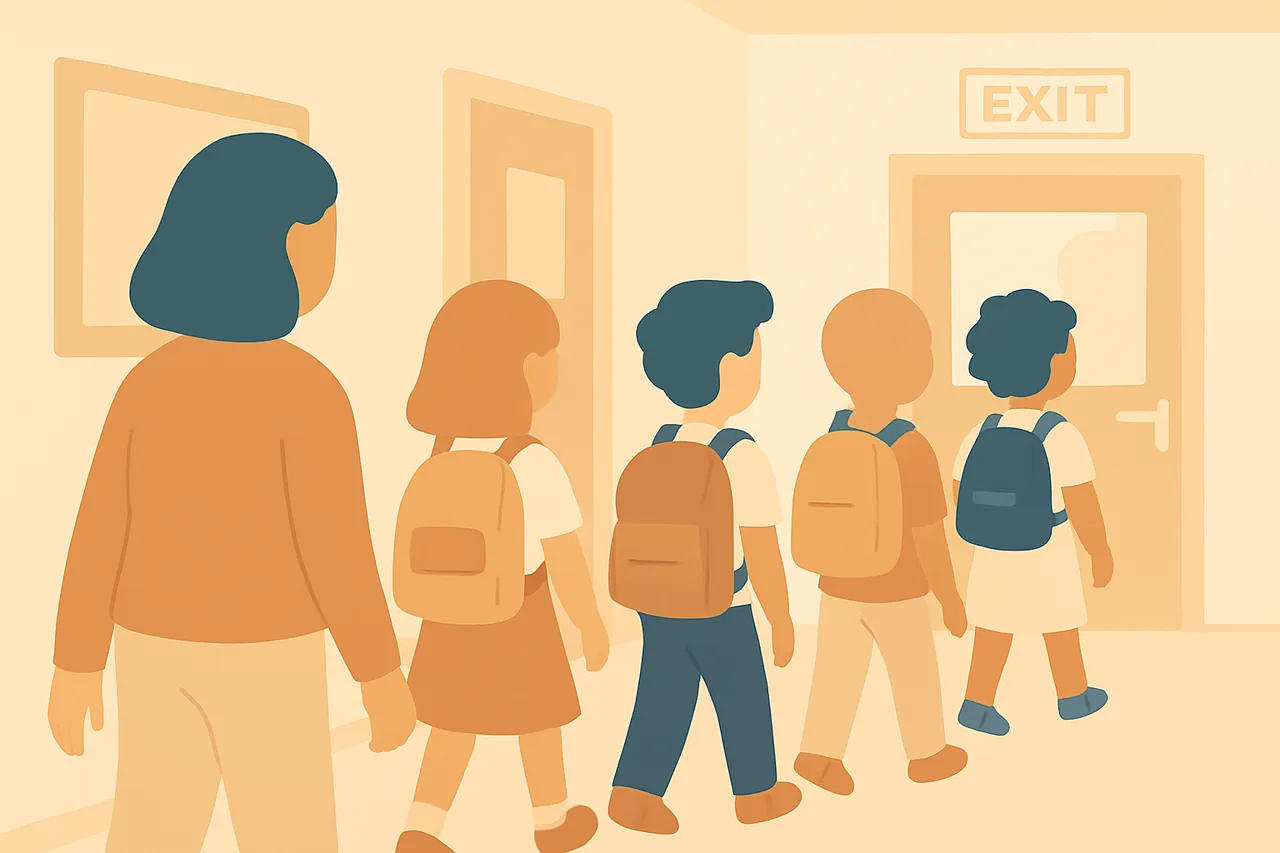
Why is the hallway so hard for autistic K-5 students?
The hallway is the loudest, most crowded, least predictable space in an elementary school, and it has no seat. Every other part of the day has an anchor: a desk, a carpet square, a table. The hallway removes that anchor and adds sixty other bodies moving in two directions. A 2025 study in a peer-reviewed journal of an autism-friendly school environment model found that uniform sensory adjustments to school spaces, including noise control, lighting changes, and quiet zones, were associated with significant improvements on the Autism Behavior Checklist. That finding matters for your story: if the hallway itself is the problem, a narrative alone may not be enough, and you should say so in the IEP notes.
So the story has two jobs. It has to make the hallway predictable, and it has to give the student one thing to do with their body.
What should each page of a hallway social story say?
Six pages, one beat each. This is the structure that survives contact with an actual K-5 caseload.
| Page | Beat | Example sentence | Sentence type |
|---|---|---|---|
| 1 | When it happens | "After math, my class walks to the library." | Descriptive |
| 2 | What the space is like | "The hallway is long. Sometimes it is loud because other classes are walking too." | Descriptive |
| 3 | What others are doing | "My classmates walk in a line. My teacher walks at the front." | Descriptive |
| 4 | How people feel | "Some kids feel excited in the hallway. Some kids feel like it is too loud. Both are okay." | Perspective |
| 5 | What I can do | "I can put my hands on my hips and follow the person in front of me." | Directive (the only one) |
| 6 | What happens next | "When we get to the library, I sit down. My teacher is glad we got there safely." | Affirmative |
Count the ratio. Four descriptive or perspective sentences, one directive. That clears the 2:1 minimum in Carol Gray methodology comfortably. Most hallway stories written under time pressure invert this and become a list of "I will not run, I will not touch the walls, I will not talk" lines, which reads as a behavior plan rather than a social story.
From the same 2024 survey: "I wish I had a template I could easily customize to change the pictures of the child or parents quickly but keep the same story." The hallway is the clearest case for this. The scaffold above is identical for every student in your building. Only the route, the destination, and the coping strategy change.
Which hallway should the story actually describe?
One route, not the concept of hallways. A student who can walk to the cafeteria calmly may fall apart on the way to the gym, because the gym route passes the loud kindergarten wing. Pick the single transition that is failing, and write that route with its real landmarks: the water fountain, the blue door, the turn by the office.
If the student has three hard transitions, write three short stories rather than one long generic one. Specificity is the entire mechanism. A story that says "sometimes hallways are loud" gives the student nothing to anticipate. A story that says "when we pass the kindergarten rooms, it gets louder for about ten steps" gives them a countdown.
What coping strategy should go on the directive page?
Pick one, and make it something the student can do while moving. Common options that hold up in a K-5 hallway:
| Strategy | Best for | Watch out for |
|---|---|---|
| Hands on hips or in pockets | Students who touch walls, lockers, or classmates | Hard to sustain past 30 seconds for some students |
| Carry an object (clipboard, book, ball) | Students who need proprioceptive input | Becomes a preferred item and a new negotiation |
| Follow one named classmate | Students who lose the line or wander | Depends on that classmate being present that day |
| Noise-reducing headphones | Students with documented auditory sensitivity | Needs team agreement and a plan for who carries them |
| Leave 60 seconds before the bell | Students overwhelmed by crowd density | Requires teacher buy-in, not just an SLP decision |
Whichever you choose, write it in the story exactly as the student will do it. "I can take a break" is not a strategy. "I can stop by the water fountain and count to five" is.
Does the research support using a social story for a transition like this?
Partly, and it is worth knowing where the line is. A 2026 meta-analysis in Frontiers in Psychology pooled 21 single-case experimental studies covering 61 autistic participants and found a moderate overall effect (Tau-U = 0.743), strongest for school-aged children 7 to 12. It found significant positive effects for social skills, safety skills, and reducing problem behaviors, but not for classroom adaptive skills. A hallway transition sits close to that boundary. It is part safety skill, part routine compliance.
The ASSSIST-2 cluster randomized trial of 249 autistic children aged 4 to 11 across 87 schools points the same direction. Children using social stories met their individual goals significantly more often than usual care, but broad measures of social responsiveness did not move. In practical terms: a hallway story may help this student get to the library. It is not a general social skills intervention, and it should be written into the IEP as a specific, observable goal.
Social narratives as a category are listed as an evidence-based practice by AFIRM at UNC and the National Clearinghouse on Autism Evidence and Practice, across ages 3 to 22.
How do you know if the hallway story is working?
Pick one countable thing before you start. The usual candidates:
- Prompts required. How many verbal redirects from the classroom door to the destination. Baseline it for three days first.
- Distance completed independently. Useful for students who make it halfway and then stall.
- Time to arrive. Blunt, but easy for a paraprofessional to record without a data sheet.
- Elopement attempts. Only if this is a safety case, in which case the story is a supplement to a safety plan and never a replacement for one.
Give it two to three weeks of daily readings before you judge. If prompts have not dropped at all, the problem is usually sensory load rather than comprehension, and the next move is an environmental change, not a longer story.
Frequently Asked Questions
How long should a hallway social story be?
Five to six pages, 8 to 12 sentences total. The hallway transition itself lasts about 90 seconds, so the story has to be shorter than the walk. If the student cannot finish it standing at the classroom door, it is too long.
Should the hallway story say "walk quietly" or "use a quiet voice"?
Use a quiet voice. "Quietly" is an abstract adverb that many K-5 students cannot map to a specific action. "A quiet voice" names a behavior the student can produce and an adult can model. Carol Gray methodology favors concrete, literal wording over vague qualifiers.
What if the student runs in the hallway rather than walks?
Running in the hallway and eloping from the hallway are different behaviors and need different stories. If the student is heading for an exit or leaving the building, that is elopement and it needs a safety plan, not just a narrative. If the student is simply moving fast because the hallway is overwhelming, a hallway story plus a movement break before the transition is usually the better pairing.
Can one hallway social story cover the whole class?
A class-wide version is a social narrative, not a Carol Gray social story, because Gray's methodology is built around one student's perspective. The class version still works if you keep the same descriptive-to-directive ratio and drop the first-person pronouns. Many school SLPs write the class narrative first and then personalize one copy for the student on their caseload.
Do I need real photos of my school's hallway?
Photos of the actual hallway help more here than in most scenarios because the story is about one specific physical space. An empty hallway photographed after dismissal avoids student faces entirely and sidesteps most FERPA and consent friction. Photograph the doorway, the floor markers, the turn, and the destination.
How many times should the student read the hallway story before it works?
Plan on reading it before the transition, not during, and expect two to three weeks of daily readings before you judge it. In the ASSSIST-2 trial the protocol was at least six readings over four weeks. A hallway transition happens five or more times a day, so the natural practice volume is high.
What if the hallway story does not change the behavior at all?
Check whether the problem is understanding or sensory load. A social story may help a student who does not know the expectation. It will not fix a hallway that is genuinely too loud or too crowded for that student. If the sensory environment is the driver, pair the story with an environmental change such as leaving 60 seconds early or wearing headphones.
One approach for school SLPs short on time is to keep a 5-tool stack: a methodology checklist for the descriptive-to-directive ratio, a slide template you reuse for every route in the building, a folder of empty-hallway photos taken after dismissal, an AI text drafter (ChatGPT, Claude, MagicSchool, or Emoquest for one-sentence-in story output), and a delivery format your district already uses such as Google Slides or PDF. Build the hallway scaffold once. After that, only the route changes.