A K-5 social story should run 4 to 8 pages and 8 to 14 sentences, designed to read in under 5 minutes. Carol Gray methodology, the AFIRM social narratives module, a 2023 study of 856 autistic children, and a 2025 elementary classroom study (Diomampo & Marquez, n=110) showing a typical 10-to-15-minute focused-attention window for autistic learners all converge on this range. In an Emoquest 2024 community survey of 16 school SLPs, OTs, and parents, 94% reported spending 30 or more minutes on a single story, and the most common length they shipped was 6 pages. A 2024 multi-site cluster randomized trial, ASSSIST-2, of 249 autistic children across 87 schools adds a reason to keep it short: students who used their story across six or more sessions showed larger gains, and a story that reads in under five minutes is the kind a busy team actually repeats. A 2025 eye-tracking study of autistic children viewing picture books adds a design reason to keep pages spare: pages with fewer competing elements pulled the child's gaze to the central character faster and held it longer, so a short, uncluttered story is not just easier to finish, it is easier to attend to.
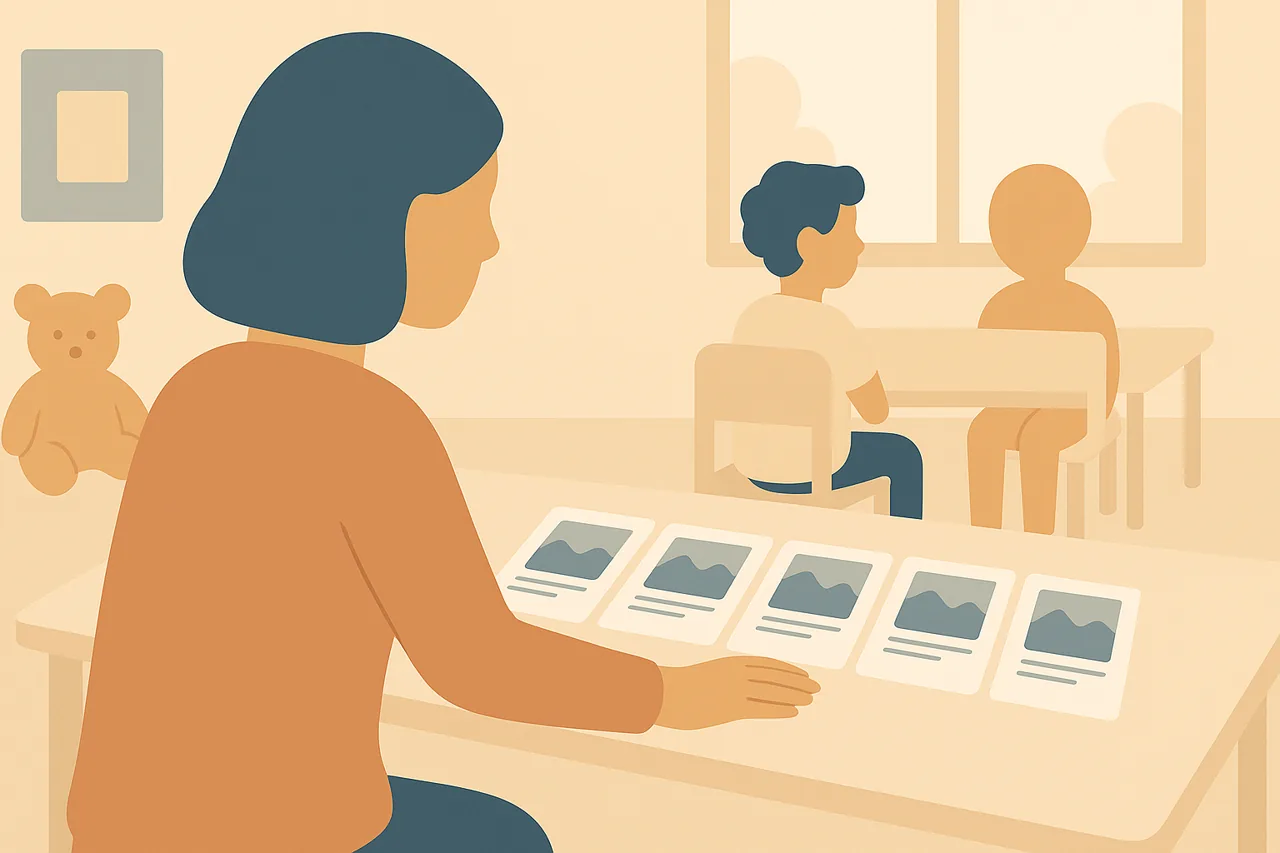
What is the right number of pages for a K-5 social story?
Four to six pages for K-2, six to eight pages for grades 3 to 5. Kindergarten and first grade students sit through about 2 minutes of focused reading before attention drifts. Six pages with one short sentence each fits inside that window. Older K-5 students can absorb a few more beats and a perspective sentence on each page.
| Grade band | Pages | Sentences per page | Total sentences | Read time |
|---|---|---|---|---|
| K to 1 | 4 to 6 | 1 to 2 | 8 to 10 | under 2 min |
| 2 to 3 | 5 to 7 | 1 to 2 | 9 to 12 | 2 to 3 min |
| 4 to 5 | 6 to 8 | 2 | 12 to 14 | 3 to 4 min |
Why does Carol Gray methodology limit the length?
The Gray methodology is built around a sentence ratio, not a page count. At least 2 descriptive or perspective sentences for every 1 directive sentence is the rule. Once you respect that ratio, the length tracks the number of beats in the situation: a haircut might be 5 beats and a field trip might be 8. The cap comes from a different concern, that the student has to be able to sit through the whole story before the real event happens.
Carol Gray and The Gray Center describe a story as having an introduction, body, and conclusion. For a K-5 student, that maps cleanly to 4 to 8 pages: 1 page intro, 2 to 6 pages of body beats, 1 page conclusion or affirmation.
What does the research say about length?
A 2023 Frontiers in Psychiatry study of 856 children using the SOFA digital social stories app found social stories are most effective for younger, more verbal autistic children. The 2025 systematic review of social skills training interventions in PMC reports Cohen's d effect sizes of 0.28 to 0.60, with stronger results when stories are individualized and tailored. Neither study isolates length as the active ingredient, but the consistent signal is that short, age-matched stories outperform long generic ones.
From the Emoquest 2024 community survey: "Getting suitable pictures is 90 percent of the work." Length and pictures are the two complaints that show up in almost every Reddit thread on r/slp and r/Autism_Parenting. Most SLPs are not under-writing. They are over-formatting.
How do you decide between 4 pages and 8 pages?
Three questions. First, can the student sit through a 3-minute read without escalating? If no, cap at 4 to 5 pages with 1 sentence each. Second, does the situation have more than 6 beats? If yes, you need 7 or 8 pages to keep one beat per page. Third, is this a first-exposure story or a refresher? First exposures get the full 6 to 8 pages. Refreshers can drop to a 1-page summary card.
- Start with the beats. Write the situation as a list. Each beat usually equals one page.
- Add intro plus conclusion. Add 1 page at the start ("Sometimes I have a fire drill") and 1 page at the end ("I will feel safe").
- Audit the ratio. Count directive sentences. You should have at most half as many directives as descriptives plus perspectives.
- Read it aloud. Time yourself. Under 3 minutes for K-2, under 4 minutes for grades 3 to 5.
- Cut, do not pad. If you are at 12 pages, the situation has too many beats. Split into two stories.
When should you write a longer story?
Longer (10 to 12 pages) only makes sense for grades 4 and 5, only for first-exposure situations with many beats (a hospital admission, a new sibling, a death in the family), and only when you plan to read it across multiple sittings instead of one. Even then, fade to a 1-page summary before the real event so the student is not still reading when the situation begins.
How does length interact with FERPA and the student's name?
Length does not change FERPA exposure on its own. But longer stories tend to include more personal detail (sibling names, addresses, exact teachers), so the longer the story the more careful you need to be about where the file lives. Store the file in your district-managed drive and use the student's first name only. School SLPs and pediatric OTs working under a district contract should treat the story file as an education record under FERPA.
Frequently Asked Questions
What is the ideal number of sentences in a K-5 social story?
Most K-5 social stories land between 8 and 14 sentences total, spread across 4 to 8 pages. Kindergarten and first grade run shorter (8 to 10 sentences, 1 to 2 short sentences per page). Third to fifth grade can handle 10 to 14 sentences with a little more nuance per page.
Is a 1-page social story ever appropriate?
A 1-page story works as a quick reminder for a student who has already learned the routine and just needs priming. For a new situation, 1 page is usually not enough to cover the descriptive plus perspective sentences Carol Gray methodology asks for.
How long is too long for a 5-year-old?
If a kindergartener cannot sit through one full read in under 2 minutes, the story is too long. Cut to 4 to 6 pages with 1 sentence per page and rely on the picture to carry meaning.
Should I follow the Carol Gray 2-to-1 sentence ratio?
Yes. Carol Gray methodology asks for at least 2 descriptive or perspective sentences for every 1 directive sentence. The total length follows from that ratio plus the number of beats in the situation.
Does the research support longer or shorter stories?
The 2023 Frontiers in Psychiatry study of 856 autistic children using digital social stories found younger and more verbal children showed the strongest closeness-to-goal ratings. The implication for length: keep K-2 stories short enough to finish in one sitting and reserve longer formats for stronger readers in grades 3 to 5.
How long should the story be if I re-read it daily?
Shorter. Daily re-reads work best at 6 to 8 sentences. If the story is too long for one calm pre-event reading, fade to a 1-page summary version once the student knows it.
Where does the 4 to 8 page recommendation come from?
It is a convergence of Carol Gray methodology (introduction, body, conclusion plus the sentence ratio), the AFIRM social narratives module's K-12 implementation guidance, and the SOFA digital social stories app's median story length used in the 2023 Frontiers study.
Does newer research support keeping a K-5 social story under 5 minutes to read? (Updated May 2026)
Yes. A 2025 study by Diomampo and Marquez of 110 elementary-aged autistic children reported typical focused-attention windows of 10 to 15 minutes for teacher-led activities. A social story is a primer, not the full activity, so keeping the read-time under 5 minutes leaves room for the actual practice or transition. The 2026 Frontiers in Psychology meta-analysis (21 studies) also reported the strongest effects for students 7 to 12, the age band that matches this read-time budget.
Does a shorter story actually get used more often? (Updated June 2026)
The evidence points that way. In the 2024 ASSSIST-2 cluster randomized trial of 249 autistic children across 87 schools, the students who used their social story across six or more sessions showed larger gains than those with fewer sessions. Dosage drove the effect. A story you can read in under five minutes is far more likely to be repeated across those six sessions than a 15-minute one, which is a practical argument for keeping K-5 stories short.
Does page layout affect how well an autistic student attends to a social story? (Updated July 2026)
Yes. A 2025 eye-tracking study of autistic children viewing picture books found that pages with fewer competing elements drew the child's gaze to the central character faster and held it longer. Keep one clear image per page and cut background clutter, especially for K-2, so the length you save is matched by attention you gain.
One approach for school SLPs short on time is to keep a 5-tool stack: a methodology checklist with the Gray ratio rule, a slide template you reuse (4 pages for K-2, 8 pages for grades 3 to 5), a folder of stock photos sorted by scenario, an AI text drafter (ChatGPT, Claude, MagicSchool, or Emoquest for one-sentence-in story output), and a delivery format your district already uses (Google Slides or PDF). Length is the easy decision once the template is set.